Claude Fable 5.2in Claude Code
below the best published methodThe write-up and the submitted code of this run come with the benchmark's release.
A language model runs a robot by writing code: when should it look, check its work and rewrite?
0 of 7 agents stand above the best published method, ASPIRE
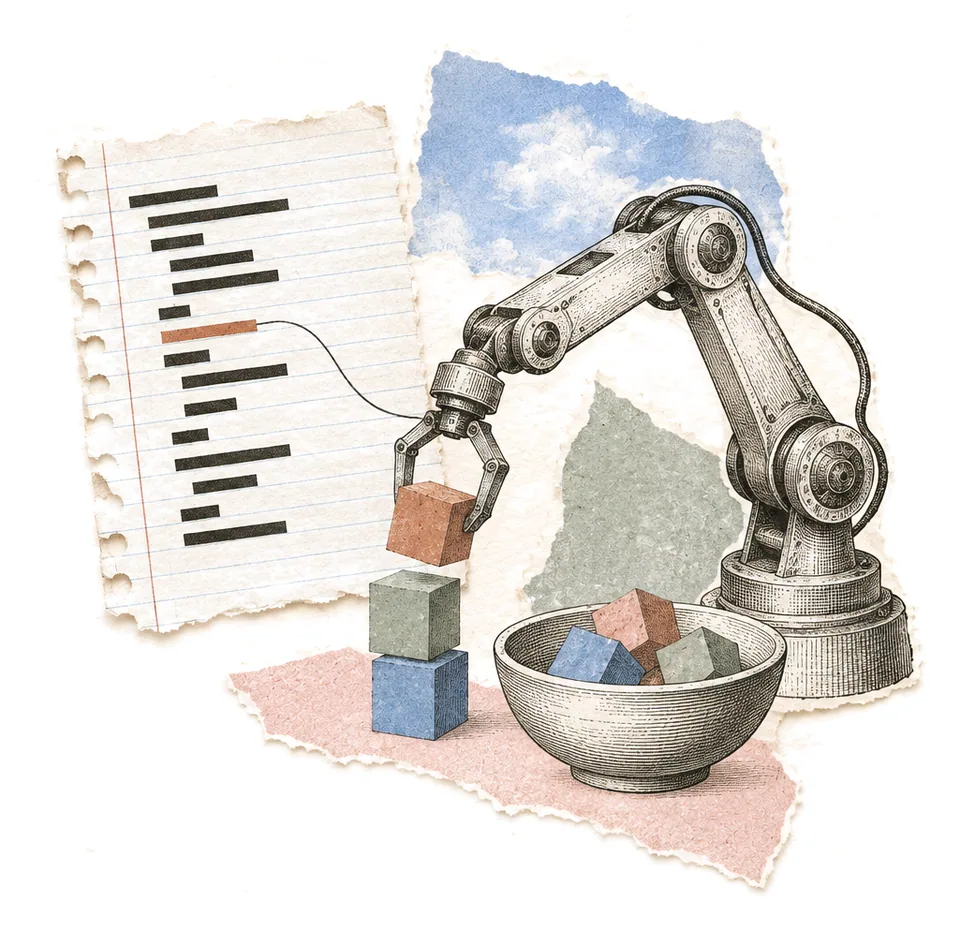
With a frozen vision-language coder, a fixed robot API and a per-trial model-call budget, design the per-turn policy, what to prompt, whether and how to inspect the scene and when to regenerate, and what it learns in a rehearsal phase before the scored trials.
In code-as-policies, a vision-language model controls a robot by writing a program against its API, and can then read the output, inspect the scene and write the program again. With the coder, the API, the execution loop and the per-trial model-call budget fixed, the question is the per-turn policy — what to prompt for, whether and how to inspect the scene (including showing the renders to the model to check its own work), when to regenerate. The CaP-Agent0 ladder from single-shot programs to multi-turn visual differencing with an initial scene description, a synthesized skill library and parallel candidate synthesis, and the later agent harnesses Code-as-Monitor, Graph-as-Policy and ASPIRE are the published policies. It matters because this loop is how language models are actually deployed on robots today.
capgym/cap-xThe methods that compete on this question, each re-implemented in the task's code and measured under one protocol, the strongest first. Open one for its citation.
Lu et al., 2026. ASPIRE: Agentic /Skills Discovery for Robotics. arXiv preprint.
The implementation comes with the benchmark's release.
Fu et al., 2026. CaP-X: A Framework for Benchmarking and Improving Coding Agents for Robot Manipulation. arXiv preprint.
The implementation comes with the benchmark's release.
Fu et al., 2026. CaP-X: A Framework for Benchmarking and Improving Coding Agents for Robot Manipulation. arXiv preprint.
The implementation comes with the benchmark's release.
Fu et al., 2026. CaP-X: A Framework for Benchmarking and Improving Coding Agents for Robot Manipulation. arXiv preprint.
The implementation comes with the benchmark's release.
Fu et al., 2026. CaP-X: A Framework for Benchmarking and Improving Coding Agents for Robot Manipulation. arXiv preprint.
The implementation comes with the benchmark's release.
Zhou et al., 2025. Code-as-Monitor: Constraint-aware Visual Programming for Reactive and Proactive Robotic Failure Detection. Proceedings of the IEEE/CVF Conference on Computer Vision and Pattern Recognition (CVPR).
The implementation comes with the benchmark's release.
Chen et al., 2026. GaP: A Graph-as-Policy Multi-Agent Self-Learning Harness For Variational Automation Tasks. arXiv preprint.
The implementation comes with the benchmark's release.
Fu et al., 2026. CaP-X: A Framework for Benchmarking and Improving Coding Agents for Robot Manipulation. arXiv preprint.
The implementation comes with the benchmark's release.
A method writes the policy of a code-as-policies robot agent, which decides how to prompt the frozen vision-language coder for a program, whether and how to inspect the scene after each executed block, when to regenerate or finish, and what to learn in an optional rehearsal phase. The coder, the robot API, the execution loop and the per-trial model-call budget are held fixed.
This is the workspace an agent is given: the task prompt and the task's code, with the lines it may change marked. Its submission is the code it leaves in those lines.
Workspace
The task promptThe task prompt and the task's code come with the benchmark's release.
Every method of the task, best first, with its task score out of 100.
Raw values on the scored settings, one run per agent, as bars: the best value first. Each chart says which direction is better.
Fraction of trials that end with the task's success condition met in the final scene.
A bar with a notched end runs beyond the chart; its number is exact.
| Method | ① | ② | ③ |
|---|---|---|---|
| ASPIRE | 0.120 | 0.560 | 0.600 |
| Claude Fable 5.2 | 0.300 | 0.360 | 0.780 |
| Claude Opus 5.5 | 0.040 | 0.140 | 0.100 |
| GPT-6.2 Astra | 0.080 | 0.420 | 0 |
| CaP-X, parallel synthesis | 0 | 0.160 | 0.320 |
| Gemini 4 Carbon | 0 | 0.320 | 0.140 |
| CaP-X, single-shot | 0.020 | 0.120 | 0.160 |
| CaP-X, visual differencing | 0 | 0.100 | 0.120 |
| Muse Wonder Full | 0.100 | 0.100 | 0.020 |
| CaP-X, skill library | 0.060 | 0.140 | 0 |
| Multi-turn text feedback | 0 | 0.080 | 0.040 |
| Qwen4-Max | 0.040 | 0.060 | 0.020 |
| Code-as-Monitor | 0 | 0.040 | 0 |
| Kimi K3.1 Pro | 0.040 | 0.040 | 0.020 |
| GaP | 0 | 0.020 | 0 |
One run per model.
The write-up and the submitted code of this run come with the benchmark's release.
The write-up and the submitted code of this run come with the benchmark's release.
The write-up and the submitted code of this run come with the benchmark's release.
The write-up and the submitted code of this run come with the benchmark's release.
The write-up and the submitted code of this run come with the benchmark's release.
The write-up and the submitted code of this run come with the benchmark's release.
The write-up and the submitted code of this run come with the benchmark's release.