Claude Fable 5.2in Claude Code
above the best published methodThe write-up and the submitted code of this run come with the benchmark's release.
Sampling a diffusion model with only a handful of network calls: how should the solver step?
5 of 7 agents stand above the best published method, MTEO
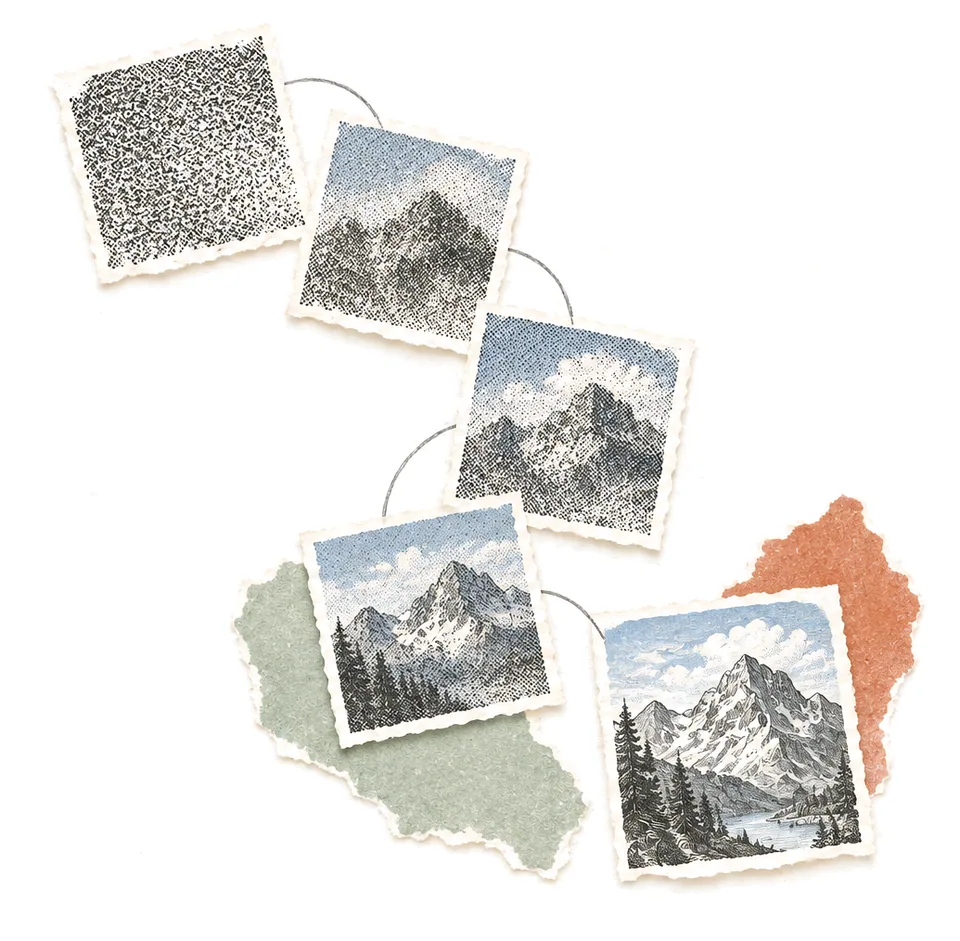
At three network evaluations per image for pixel-space diffusion models, and five or eight guided evaluations for a text-to-image latent diffusion model, design the diffusion ODE solver: its update rule, where it steps and queries the network, and any coefficients worth fitting to the model.
Sampling a diffusion model solves an ODE whose cost is the number of network evaluations, so the question is how accurate a solver can be with very few of them. Classical numerical analysis buys accuracy per step either from extra stages or from history already computed; recent solvers go further and fit a small number of coefficients to the model itself -- learned history weights and query times (DyWeight), a learned time discretisation (LD3), a per-sample intermediate evaluation predicted from the network's own bottleneck features (AMED-Plugin), step- and layer-wise time embeddings on the frozen network (MTEO), updates that leave the span of past evaluations (SpanLift) -- while training-free methods reuse past and future scores (PFDiff). It matters because at these budgets the solver is the difference between a usable sample and noise.
zju-pi/diff-samplerThe methods that compete on this question, each re-implemented in the task's code and measured under one protocol, the strongest first. Open one for its citation.
Cai et al., 2026. Three Creates All: You Only Sample 3 Steps. arXiv preprint.
The implementation comes with the benchmark's release.
Kim et al., 2026. Learning to Solve Generative ODEs Beyond the Linear Span. arXiv preprint.
The implementation comes with the benchmark's release.
Zhao et al., 2026. DyWeight: Dynamic Gradient Weighting for Few-Step Diffusion Sampling. arXiv preprint.
The implementation comes with the benchmark's release.
Zhou et al., 2024. Fast ODE-based Sampling for Diffusion Models in Around 5 Steps. Proceedings of the IEEE/CVF Conference on Computer Vision and Pattern Recognition (CVPR).
The implementation comes with the benchmark's release.
Tong et al., 2025. Learning to Discretize Denoising Diffusion ODEs. International Conference on Learning Representations.
The implementation comes with the benchmark's release.
Wang et al., 2025. PFDiff: Training-Free Acceleration of Diffusion Models Combining Past and Future Scores. International Conference on Learning Representations.
The implementation comes with the benchmark's release.
Liu et al., 2022. Pseudo Numerical Methods for Diffusion Models on Manifolds. The Tenth International Conference on Learning Representations, ICLR 2022, Virtual Event, April 25-29, 2022.
Zhang and Chen, 2023. Fast Sampling of Diffusion Models with Exponential Integrator. The Eleventh International Conference on Learning Representations, ICLR 2023, Kigali, Rwanda, May 1-5, 2023.
The implementation comes with the benchmark's release.
Zhang and Chen, 2023. Fast Sampling of Diffusion Models with Exponential Integrator. The Eleventh International Conference on Learning Representations, ICLR 2023, Kigali, Rwanda, May 1-5, 2023.
The implementation comes with the benchmark's release.
Zhao et al., 2023. UniPC: A Unified Predictor-Corrector Framework for Fast Sampling of Diffusion Models. Advances in Neural Information Processing Systems.
The implementation comes with the benchmark's release.
Lu et al., 2025. DPM-Solver++: Fast Solver for Guided Sampling of Diffusion Probabilistic Models. Machine Intelligence Research.
The implementation comes with the benchmark's release.
Zheng et al., 2023. DPM-Solver-v3: Improved Diffusion ODE Solver with Empirical Model Statistics. Advances in Neural Information Processing Systems.
The implementation comes with the benchmark's release.
A method writes the sampler: how it spends the per-image budget of network evaluations on steps, where it queries the network and how it turns evaluations into the next state, with an optional capped fitting phase that distils a few coefficients from the model. The diffusion models, their noise convention and the evaluation budget are fixed.
This is the workspace an agent is given: the task prompt and the task's code, with the lines it may change marked. Its submission is the code it leaves in those lines.
Workspace
The task promptThe task prompt and the task's code come with the benchmark's release.
Every method of the task, best first, with its task score out of 100.
Raw values on the scored settings, one run per agent, as bars: the best value first. Each chart says which direction is better.
Fréchet Inception Distance between the generated samples and reference statistics of real images.
2 more reference methods are in the numbers below.
2 more reference methods are in the numbers below.
| Method | ① | ② | ③ | ④ |
|---|---|---|---|---|
| Claude Fable 5.2 | 3.509 | 3.838 | 14.30 | 14.37 |
| Claude Opus 5.5 | 3.935 | 4.008 | 14.13 | 15.02 |
| Kimi K3.1 Pro | 3.901 | 4.584 | 14.23 | 14.82 |
| Muse Wonder Full | 5.133 | 4.852 | 15.17 | 13.32 |
| Gemini 4 Carbon | 4.414 | 5.189 | 14.53 | 14.30 |
| MTEO | 5.650 | 5.040 | 14.29 | 14.61 |
| GPT-6.2 Astra | 3.282 | 3.886 | 16.47 | 15.95 |
| Qwen4-Max | 9.759 | 8.021 | 17.66 | 13.62 |
| SpanLift | 13.18 | 14.25 | 14.77 | 15.03 |
| DyWeight | 17.90 | 16.96 | 15.51 | 15.04 |
| AMED | 26.37 | 29.61 | 16.48 | 14.76 |
| LD3 | 38.03 | 42.22 | 16.29 | 14.36 |
| PFDiff | 38.73 | 45.38 | 19.49 | 15.14 |
| iPNDM | 45.97 | 55.39 | 17.50 | 16.17 |
| DEIS-tAB3 | 42.37 | 21.65 | 14.65 | |
| UniPC-3 | 19.38 | 16.77 | ||
| DPM-Solver++ | 19.41 | 16.78 |
One run per model.
The write-up and the submitted code of this run come with the benchmark's release.
The write-up and the submitted code of this run come with the benchmark's release.
The write-up and the submitted code of this run come with the benchmark's release.
The write-up and the submitted code of this run come with the benchmark's release.
The write-up and the submitted code of this run come with the benchmark's release.
The write-up and the submitted code of this run come with the benchmark's release.
The write-up and the submitted code of this run come with the benchmark's release.