Claude Fable 5.2in Claude Code
above the best published methodThe write-up and the submitted code of this run come with the benchmark's release.
Training with the whole team in view, so that agents acting on what each sees alone cooperate best.
4 of 7 agents stand above the best published method, PQN-VDN
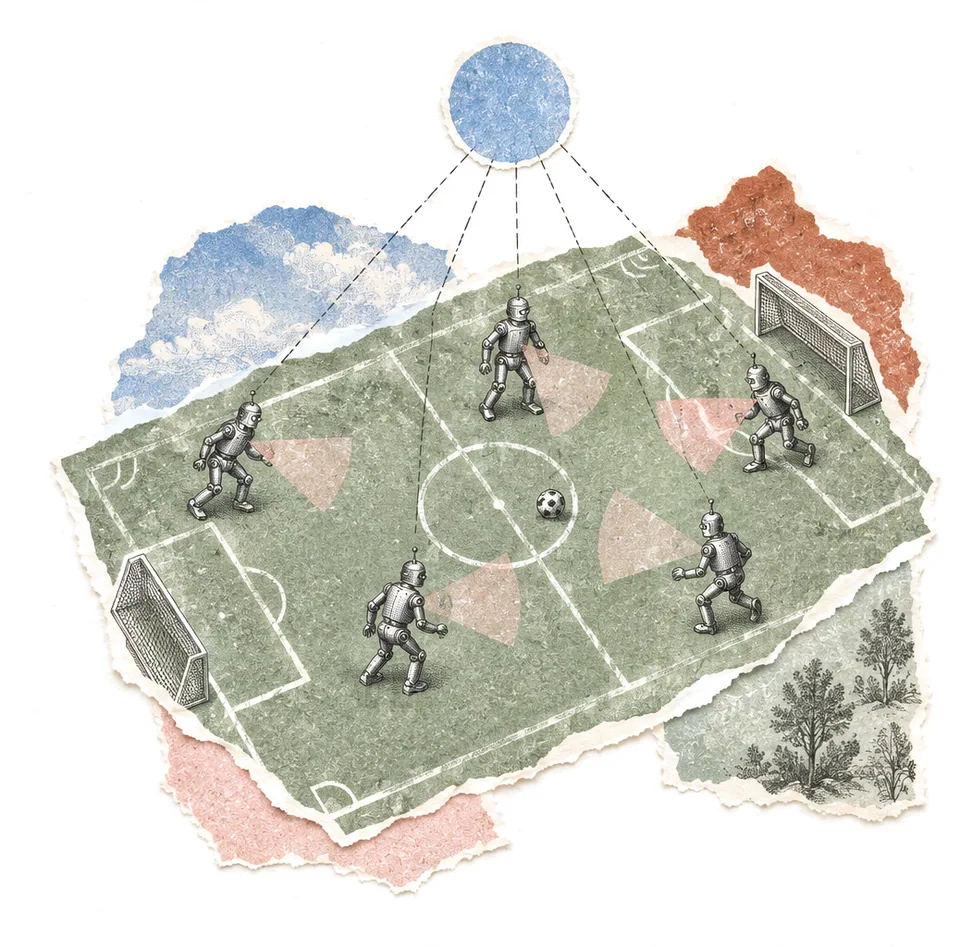
With the environments, the 20M-step budget, the deployable decentralised actor family and the evaluation fixed, design the centralised training algorithm (behaviour policy, critics or guiders, credit assignment, update rule) that produces the best decentralised team.
In cooperative multi-agent RL each agent finally acts on its own partial view, yet training may use the global state, all agents' actions and even a coordinated joint policy. How that privileged information is turned into the learning signal for the deployed policies is the live question behind MAPPO's centralised critic, HAPPO's sequential trust-region updates, MACA's multi-level counterfactual credit assignment, teacher-student distillation, MAGPO's guided policy optimisation (ICLR 2026), agent-side modelling of the unobserved state from local histories (SMPE², MA²E), and value factorisation, where a centralised joint value decomposes into per-agent greedy actions (QMIX, QPLEX, PQN-VDN).
instadeepai/MavaThe methods that compete on this question, each re-implemented in the task's code and measured under one protocol, the strongest first. Open one for its citation.
Gallici et al., 2025. Simplifying Deep Temporal Difference Learning. International Conference on Learning Representations.
The implementation comes with the benchmark's release.
Zhao and Xie, 2025. Multi-level Advantage Credit Assignment for Cooperative Multi-Agent Reinforcement Learning. Proceedings of The 28th International Conference on Artificial Intelligence and Statistics.
The implementation comes with the benchmark's release.
li et al., 2026. Multi-Agent Guided Policy Optimization. International Conference on Learning Representations.
The implementation comes with the benchmark's release.
Wang et al., 2021. QPLEX: Duplex Dueling Multi-Agent Q-Learning. 9th International Conference on Learning Representations, ICLR 2021, Virtual Event, Austria, May 3-7, 2021.
The implementation comes with the benchmark's release.
Rashid et al., 2018. QMIX: Monotonic Value Function Factorisation for Deep Multi-Agent Reinforcement Learning. Proceedings of the 35th International Conference on Machine Learning.
The implementation comes with the benchmark's release.
li et al., 2026. Multi-Agent Guided Policy Optimization. International Conference on Learning Representations.
Mahjoub et al., 2025. Sable: a Performant, Efficient and Scalable Sequence Model for MARL. Proceedings of the 42nd International Conference on Machine Learning.
The implementation comes with the benchmark's release.
Kang et al., 2025. MA²E: Addressing Partial Observability in Multi-Agent Reinforcement Learning with Masked Auto-Encoder. International Conference on Learning Representations.
The implementation comes with the benchmark's release.
Kuba et al., 2022. Trust Region Policy Optimisation in Multi-Agent Reinforcement Learning. The Tenth International Conference on Learning Representations, ICLR 2022, Virtual Event, April 25-29, 2022.
Zhong et al., 2024. Heterogeneous-Agent Reinforcement Learning. Journal of Machine Learning Research.
The implementation comes with the benchmark's release.
Witt et al., 2020. Is Independent Learning All You Need in the StarCraft Multi-Agent Challenge?. arXiv preprint.
Yu et al., 2022. The Surprising Effectiveness of PPO in Cooperative Multi-Agent Games. Advances in Neural Information Processing Systems.
The implementation comes with the benchmark's release.
Kontogiannis et al., 2025. Enhancing Cooperative Multi-Agent Reinforcement Learning with State Modelling and Adversarial Exploration. Proceedings of the 42nd International Conference on Machine Learning.
The implementation comes with the benchmark's release.
Yu et al., 2022. The Surprising Effectiveness of PPO in Cooperative Multi-Agent Games. Advances in Neural Information Processing Systems.
The implementation comes with the benchmark's release.
A method writes the whole centralised training algorithm: the behaviour policy, any critics, guiders or mixing networks, the advantages or targets and the update rule, and it chooses the deployed actor from a fixed family. The environments, the environment-step budget and the family of decentralised actors, with its parameter cap, stay fixed.
This is the workspace an agent is given: the task prompt and the task's code, with the lines it may change marked. Its submission is the code it leaves in those lines.
Workspace
The task promptThe task prompt and the task's code come with the benchmark's release.
Every method of the task, best first, with its task score out of 100.
Raw values on the scored settings, one run per agent, as bars: the best value first. Each chart says which direction is better.
The deployed decentralised team's win rate or mean episode return, depending on the setting.
3 more reference methods are in the numbers below.
3 more reference methods are in the numbers below.
3 more reference methods are in the numbers below.
3 more reference methods are in the numbers below.
| Method | ① | ④ | ② | ③ |
|---|---|---|---|---|
| Gemini 4 Carbon | 0.804 | 0.580 | 9.616 | 30.65 |
| Muse Wonder Full | 0.834 | 0.631 | 4.427 | 17.00 |
| PQN-VDN | 0.824 | 0.631 | 3.990 | 17.29 |
| Claude Opus 5.5 | 0.814 | 0.451 | 8.776 | 22.25 |
| Kimi K3.1 Pro | 0.766 | 0.524 | 5.146 | 26.26 |
| Qwen4-Max | 0.806 | 0.626 | 3.966 | 13.01 |
| MACA | 0.843 | 0.384 | 6.274 | 19.91 |
| MAGPO | 0.753 | 0.395 | 7.532 | 20.73 |
| QPLEX | 0.743 | 0.512 | 2.000 | 7.776 |
| Recurrent MAPPO | 0.746 | 0.262 | 0.013 | 19.27 |
| QMIX | 0.720 | 0.539 | 0.328 | 2.841 |
| CTDS | 0.681 | 0.360 | 4.294 | 11.88 |
| MA²E | 0.561 | 0.221 | 4.085 | 15.33 |
| HAPPO | 0.523 | 0.201 | 4.199 | 16.16 |
| IPPO | 0.674 | 0.250 | 0 | 0 |
| SMPE² | 0.546 | 0.308 | 0.010 | 5.560 |
One run per model.
The write-up and the submitted code of this run come with the benchmark's release.
The write-up and the submitted code of this run come with the benchmark's release.
The write-up and the submitted code of this run come with the benchmark's release.
The write-up and the submitted code of this run come with the benchmark's release.
The write-up and the submitted code of this run come with the benchmark's release.
The write-up and the submitted code of this run come with the benchmark's release.
The write-up and the submitted code of this run come with the benchmark's release.