Claude Fable 5.2in Claude Code
above the best published methodThe write-up and the submitted code of this run come with the benchmark's release.
Searching a learned world model for the actions that reach a goal, on a fixed budget of model calls.
4 of 7 agents stand above the best published method, iCEM
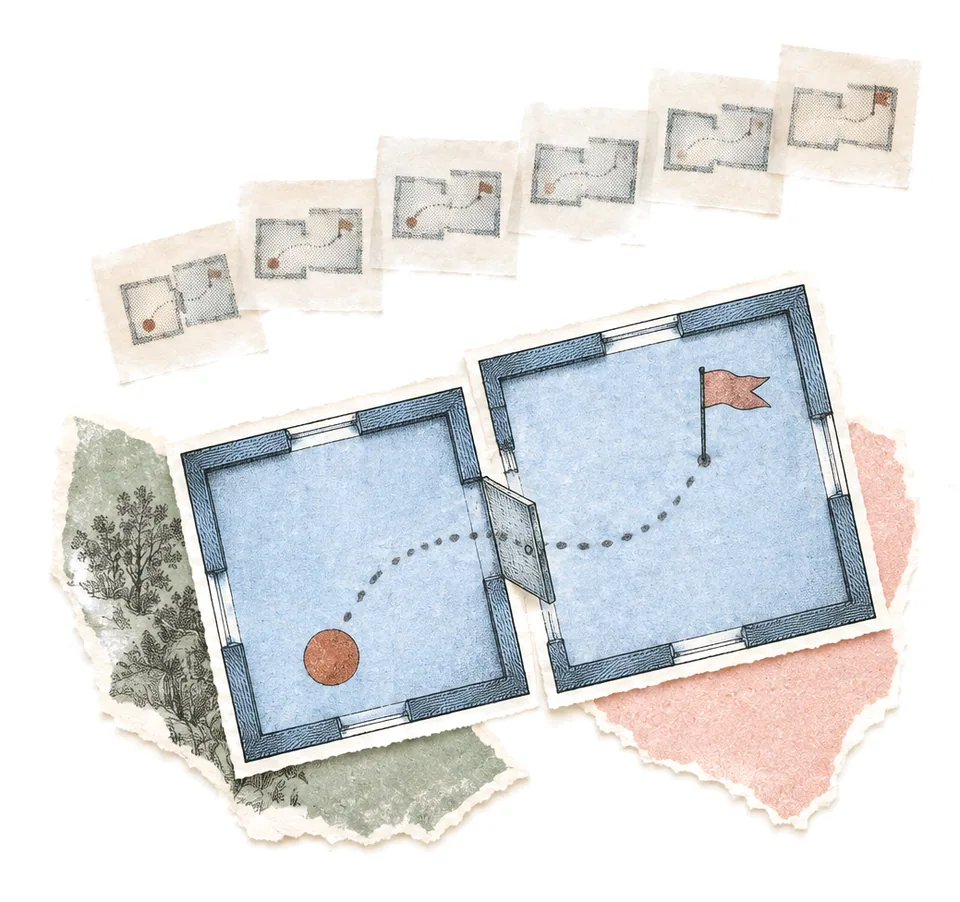
With the JEPA world models fixed, design the planner that chooses action sequences in latent space, under the same model-call budget as the published planners, across navigation and manipulation.
A JEPA world model predicts future latent encodings rather than pixels, so a robot plans by searching for the actions whose predicted outcome comes closest to the goal's encoding. The field's planners range from derivative-free samplers (CEM, MPPI, iCEM, the diffusion-style annealed MPPI of DIAL-MPC and the Nevergrad evolutionary planner of JEPA-WMs) to gradient-based planners (plain gradient descent on the actions). With the world model fixed, the question is which planner exploits it best under the published planners' own budget of world-model calls. Settings follow EB-JEPA and JEPA-WMs: Two Rooms navigation with start and goal in opposite rooms, and Push-T and Wall on withheld episodes, each with two released frozen world models (DINO-WM and JEPA-WM, on the same episodes and budget) so that a planner has to work across models, with Push-T also at a longer goal distance (50 steps instead of 30) to measure how planners degrade with horizon. It matters because the planner is what turns a learned model into behaviour, and the same model succeeds or fails depending on it.
facebookresearch/jepa-wmsThe methods that compete on this question, each re-implemented in the task's code and measured under one protocol, the strongest first. Open one for its citation.
Pinneri et al., 2021. Sample-efficient Cross-Entropy Method for Real-time Planning. Proceedings of the 2020 Conference on Robot Learning.
The implementation comes with the benchmark's release.
Zhou et al., 2025. DINO-WM: World Models on Pre-trained Visual Features enable Zero-shot Planning. Proceedings of the 42nd International Conference on Machine Learning.
Terver et al., 2026. What Drives Success in Physical Planning with Joint-Embedding Predictive World Models?. Transactions on Machine Learning Research.
Terver et al., 2026. A Lightweight Library for Energy-Based Joint-Embedding Predictive Architectures. arXiv preprint.
The implementation comes with the benchmark's release.
Williams et al., 2015. Model Predictive Path Integral Control using Covariance Variable Importance Sampling. arXiv preprint.
Terver et al., 2026. A Lightweight Library for Energy-Based Joint-Embedding Predictive Architectures. arXiv preprint.
The implementation comes with the benchmark's release.
Terver et al., 2026. What Drives Success in Physical Planning with Joint-Embedding Predictive World Models?. Transactions on Machine Learning Research.
The implementation comes with the benchmark's release.
Xue et al., 2025. Full-Order Sampling-Based MPC for Torque-Level Locomotion Control via Diffusion-Style Annealing. 2025 IEEE International Conference on Robotics and Automation (ICRA).
The implementation comes with the benchmark's release.
Nagabandi et al., 2018. Neural Network Dynamics for Model-Based Deep Reinforcement Learning with Model-Free Fine-Tuning. 2018 IEEE International Conference on Robotics and Automation (ICRA).
The implementation comes with the benchmark's release.
Terver et al., 2026. What Drives Success in Physical Planning with Joint-Embedding Predictive World Models?. Transactions on Machine Learning Research.
The implementation comes with the benchmark's release.
A method writes the planner: from the current observation, the goal and the frozen world model's latent rollout, it searches for the action sequence whose predicted latents come closest to the goal, re-planning as the episode unfolds. The world models, the planning cost and the budget of predicted rollout steps per plan are fixed.
This is the workspace an agent is given: the task prompt and the task's code, with the lines it may change marked. Its submission is the code it leaves in those lines.
Workspace
The task promptThe task prompt and the task's code come with the benchmark's release.
Every method of the task, best first, with its task score out of 100.
Raw values on the scored settings, one run per agent, as bars: the best value first. Each chart says which direction is better.
Fraction of episodes that end within the environment's success tolerance of the goal.
| Method | ① | ② | ③ | ④ |
|---|---|---|---|---|
| Claude Fable 5.2 | 0.900 | 0.820 | 0.410 | 0.950 |
| Gemini 4 Carbon | 0.915 | 0.775 | 0.455 | 0.885 |
| Muse Wonder Full | 0.875 | 0.700 | 0.040 | 0.860 |
| iCEM | 0.855 | 0.715 | 0.430 | 0.825 |
| GPT-6.2 Astra | 0.555 | 0.710 | 0.475 | 0.800 |
| Qwen4-Max | 0.875 | 0.610 | 0.270 | 0.735 |
| CEM | 0.830 | 0.610 | 0.270 | 0.735 |
| Kimi K3.1 Pro | 0.890 | 0.405 | 0.205 | 0.735 |
| MPPI | 0.840 | 0.635 | 0.375 | 0.460 |
| NGOpt | 0.800 | 0.655 | 0.345 | 0.560 |
| DIAL-MPC | 0.870 | 0.215 | 0.075 | 0.235 |
| Random-shooting MPC | 0.700 | 0.145 | 0.095 | 0.160 |
| GD | 0.735 | 0.125 | 0.025 | 0.015 |
Planning success rate with the first of the setting's two released world models.
| Method | ① | ② | ③ | ④ |
|---|---|---|---|---|
| Claude Opus 5.5 | 0.905 | 0.765 | 0.400 | 0.965 |
| iCEM | 0.855 | 0.715 | 0.430 | 0.825 |
| GPT-6.2 Astra | 0.555 | 0.710 | 0.475 | 0.800 |
| CEM | 0.830 | 0.610 | 0.270 | 0.735 |
| MPPI | 0.840 | 0.635 | 0.375 | 0.460 |
| NGOpt | 0.800 | 0.655 | 0.345 | 0.560 |
| DIAL-MPC | 0.870 | 0.215 | 0.075 | 0.235 |
| Random-shooting MPC | 0.700 | 0.145 | 0.095 | 0.160 |
| GD | 0.735 | 0.125 | 0.025 | 0.015 |
Planning success rate with the second of the setting's two released world models.
| Method | ② | ③ | ④ |
|---|---|---|---|
| Claude Opus 5.5 | 0.795 | 0.430 | 0.980 |
| iCEM | 0.805 | 0.385 | 0.840 |
| GPT-6.2 Astra | 0.880 | 0.600 | 0.860 |
| CEM | 0.635 | 0.260 | 0.810 |
| MPPI | 0.660 | 0.375 | 0.685 |
| NGOpt | 0.700 | 0.345 | 0.535 |
| DIAL-MPC | 0.215 | 0.080 | 0.290 |
| Random-shooting MPC | 0.165 | 0.095 | 0.140 |
| GD | 0.105 | 0.050 | 0.040 |
One run per model.
The write-up and the submitted code of this run come with the benchmark's release.
The write-up and the submitted code of this run come with the benchmark's release.
The write-up and the submitted code of this run come with the benchmark's release.
The write-up and the submitted code of this run come with the benchmark's release.
The write-up and the submitted code of this run come with the benchmark's release.
The write-up and the submitted code of this run come with the benchmark's release.
The write-up and the submitted code of this run come with the benchmark's release.