Claude Fable 5.2in Claude Code
above the best published methodThe write-up and the submitted code of this run come with the benchmark's release.
A network can fit its data long before it generalises: which training rule removes that delay?
6 of 7 agents stand above the best published method, Muon
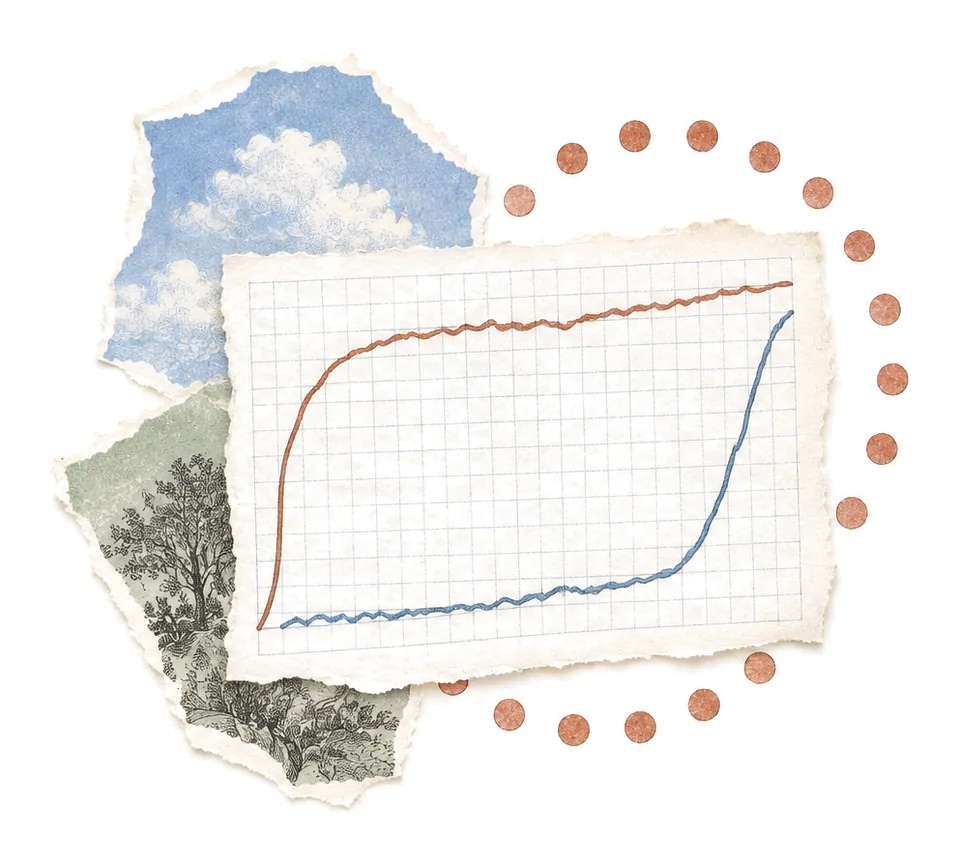
Design the training rule, update, training loss and metered use of the training data, that brings generalisation forward on grokking problems whose delay has different causes.
In grokking, a network fits a small training set almost at once but stays near chance on new data for a long time before it generalises. Which training rule, given the parameters, the gradients and a metered handle on the training data, removes that delay? The delay has different causes in different settings: an inflated initial weight norm on MNIST, softmax collapse or slow circuit formation on modular arithmetic at standard initialisation, and, on multi-step synthetic tasks (Allen-Zhu's Mano expressions and Brevo dependency graphs) learned by an 8-layer language model from a fixed sample, a long memorisation phase before the procedure itself is learned. Norm projection, slow-gradient amplification, perpendicular gradients, spectral whitening, Muon, meta-learned gradient transforms and embedding transfer from a cheaply trained weak model each win somewhere and fail elsewhere. It matters because the delay is a clean, reproducible instance of the gap between memorisation and generalisation, and a rule that closes it everywhere would say something about what generalisation needs.
KindXiaoming/OmnigrokThe methods that compete on this question, each re-implemented in the task's code and measured under one protocol, the strongest first. Open one for its citation.
Tveit et al., 2025. Muon Optimizer Accelerates Grokking. arXiv preprint.
The implementation comes with the benchmark's release.
Saheb Pasand and Dohmatob, 2026. Egalitarian Gradient Descent: A Simple Approach to Accelerated Grokking. International Conference on Learning Representations.
The implementation comes with the benchmark's release.
Lee et al., 2024. Grokfast: Accelerated Grokking by Amplifying Slow Gradients. arXiv preprint.
The implementation comes with the benchmark's release.
Lee et al., 2024. Grokfast: Accelerated Grokking by Amplifying Slow Gradients. arXiv preprint.
The implementation comes with the benchmark's release.
Chowdhery et al., 2023. PaLM: Scaling Language Modeling with Pathways. Journal of Machine Learning Research.
The implementation comes with the benchmark's release.
Zhou et al., 2025. NeuralGrok: Accelerate Grokking by Neural Gradient Transformation. arXiv preprint.
The implementation comes with the benchmark's release.
Liu et al., 2023. Omnigrok: Grokking Beyond Algorithmic Data. The Eleventh International Conference on Learning Representations, ICLR 2023, Kigali, Rwanda, May 1-5, 2023.
The implementation comes with the benchmark's release.
Xu et al., 2025. Let Me Grok for You: Accelerating Grokking via Embedding Transfer from a Weaker Model. International Conference on Learning Representations.
The implementation comes with the benchmark's release.
Prieto et al., 2025. Grokking at the Edge of Numerical Stability. International Conference on Learning Representations.
The implementation comes with the benchmark's release.
Prieto et al., 2025. Grokking at the Edge of Numerical Stability. International Conference on Learning Representations.
The implementation comes with the benchmark's release.
Liu et al., 2023. Omnigrok: Grokking Beyond Algorithmic Data. The Eleventh International Conference on Learning Representations, ICLR 2023, Kigali, Rwanda, May 1-5, 2023.
The implementation comes with the benchmark's release.
The implementation comes with the benchmark's release.
Loshchilov and Hutter, 2019. Decoupled Weight Decay Regularization. 7th International Conference on Learning Representations, ICLR 2019, New Orleans, LA, USA, May 6-9, 2019.
The implementation comes with the benchmark's release.
A method writes the training rule: the parameter update applied after each backward pass, the training loss it differentiates, and any extra metered use of the training set or of a small weak model. The data, the networks and their initialisation, the batch stream and the budget of training passes are fixed.
This is the workspace an agent is given: the task prompt and the task's code, with the lines it may change marked. Its submission is the code it leaves in those lines.
Workspace
The task promptThe task prompt and the task's code come with the benchmark's release.
Every method of the task, best first, with its task score out of 100.
Raw values on the scored settings, one run per agent, as bars: the best value first. Each chart says which direction is better.
The base-10 logarithm of the first training step at which test accuracy reaches the setting's threshold.
4 more reference methods are in the numbers below.
4 more reference methods are in the numbers below.
4 more reference methods are in the numbers below.
4 more reference methods are in the numbers below.
4 more reference methods are in the numbers below.
4 more reference methods are in the numbers below.
4 more reference methods are in the numbers below.
4 more reference methods are in the numbers below.
4 more reference methods are in the numbers below.
| Method | ① | ② | ③ | ④ | ⑤ | ⑥ | ⑦ | ⑧ | ⑨ |
|---|---|---|---|---|---|---|---|---|---|
| Claude Fable 5.2 | 0.301 | 0 | 0 | 1.342 | 1.663 | 2.167 | 3.375 | 3.250 | 2.625 |
| Muse Wonder Full | 0.778 | 0 | 0 | 1.505 | 2.167 | 1.505 | 4.699 | 3.000 | 2.875 |
| Claude Opus 5.5 | 0.778 | 0.301 | 0 | 2.000 | 1.663 | 2.250 | 3.625 | 3.125 | 2.750 |
| Gemini 4 Carbon | 0.778 | 0.477 | 0.301 | 2.417 | 2.083 | 2.250 | 3.750 | 3.000 | 2.875 |
| Kimi K3.1 Pro | 0.845 | 0.477 | 0.301 | 2.667 | 2.167 | 2.417 | 4.000 | 3.000 | 2.875 |
| Qwen4-Max | 0.903 | 0.301 | 0.301 | 2.583 | 2.250 | 2.417 | 4.250 | 4.699 | 4.699 |
| Muon | 2.083 | 2.000 | 2.083 | 3.500 | 4.167 | 2.417 | 3.625 | 2.875 | 2.875 |
| Egalitarian Gradient Descent | 2.667 | 2.667 | 2.667 | 3.083 | 5.000 | 2.833 | 3.750 | 3.000 | 2.875 |
| GPT-6.2 Astra | 0.301 | 0 | 0.301 | 0.301 | 0.699 | 0.602 | 3.875 | 2.250 | 2.250 |
| Grokfast EMA | 2.917 | 2.667 | 3.000 | 3.083 | 3.250 | 3.083 | 4.375 | 3.375 | 3.500 |
| Grokfast MA | 2.833 | 2.583 | 2.917 | 3.083 | 3.167 | 3.083 | 4.250 | 3.875 | 3.625 |
| z-loss | 4.500 | 4.583 | 4.583 | 4.250 | 3.750 | 3.000 | 3.750 | 3.250 | 2.875 |
| NeuralGrok | 3.000 | 3.000 | 3.083 | 4.333 | 3.833 | 3.083 | 3.875 | 4.250 | 3.250 |
| AdamW | 4.500 | 4.583 | 4.583 | 4.083 | 3.750 | 3.000 | 4.000 | 3.250 | 3.000 |
| Goldilocks-norm projection | 2.417 | 2.000 | 2.083 | 2.583 | 5.000 | 4.417 | 4.699 | 4.699 | 4.250 |
| GrokTransfer | 3.583 | 2.833 | 3.583 | 4.699 | 3.667 | 3.583 | 4.699 | 3.625 | 3.500 |
| StableMax | 4.167 | 4.000 | 4.083 | 4.699 | 4.833 | 5.000 | 4.000 | 4.699 | 3.500 |
| ⊥AdamW | 4.699 | 4.699 | 4.699 | 3.917 | 2.250 | 2.833 | 4.699 | 4.699 | 4.699 |
| Fixed-norm sphere | 4.699 | 4.699 | 4.699 | 3.083 | 5.000 | 4.833 | 4.699 | 4.699 | 4.699 |
| Adam without weight decay | 4.667 | 4.699 | 4.699 | 4.699 | 5.000 | 4.750 | 4.699 | 4.699 | 4.699 |
One run per model.
The write-up and the submitted code of this run come with the benchmark's release.
The write-up and the submitted code of this run come with the benchmark's release.
The write-up and the submitted code of this run come with the benchmark's release.
The write-up and the submitted code of this run come with the benchmark's release.
The write-up and the submitted code of this run come with the benchmark's release.
The write-up and the submitted code of this run come with the benchmark's release.
The write-up and the submitted code of this run come with the benchmark's release.