Claude Fable 5.2in Claude Code
above the best published methodThe write-up and the submitted code of this run come with the benchmark's release.
An emulator of a climate model's clouds and convection that holds up in warmer, unseen conditions.
5 of 7 agents stand above the best published method, Squeezeformer
On ClimSim's own training split at a fixed 5-epoch budget, design the emulator, from its architecture to its input variables, loss and training recipe, that maps a column state to sub-grid physics tendencies and still predicts well on warm and land regimes and on a warmer season it was not trained on.
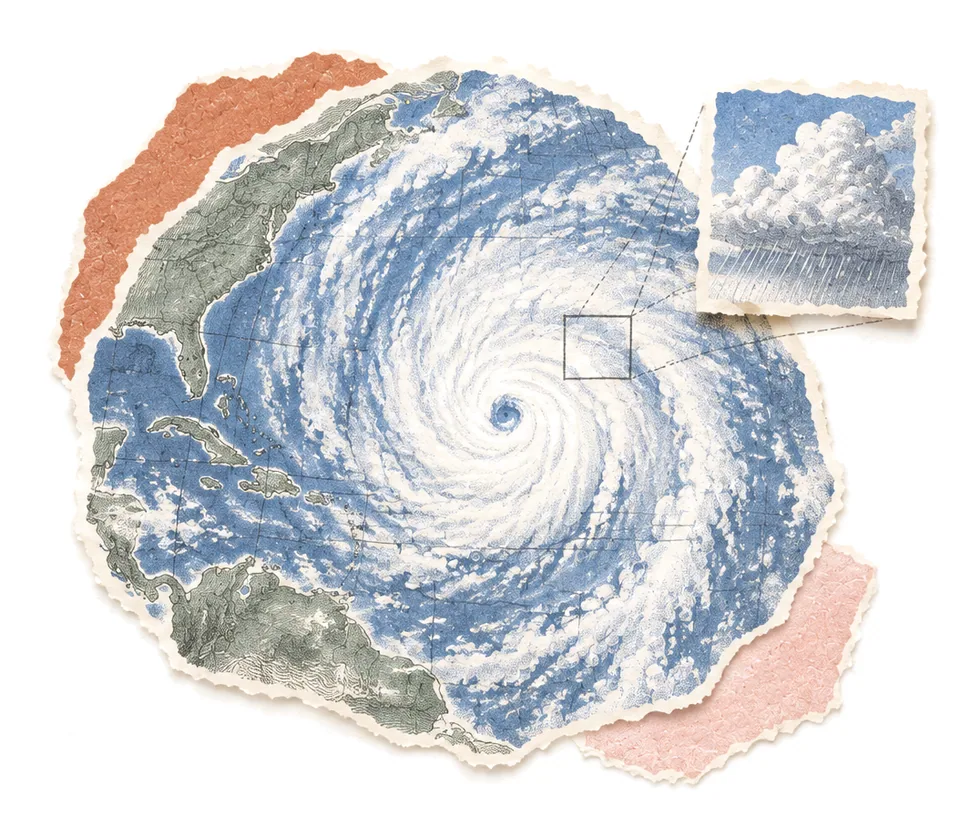
Climate models cannot resolve radiation, convection and clouds on their grid, and a network trained on high-resolution simulations of these processes can replace their costliest part. The question is whether an emulator — its architecture and, as the field varies them, its input variables, loss and training recipe — generalises beyond the columns it was trained on. It matters because a parameterisation that only works where it was fitted is not usable in a climate model, and the polar regime is exactly where the published emulators struggle.
leap-stc/ClimSimThe methods that compete on this question, each re-implemented in the task's code and measured under one protocol, the strongest first. Open one for its citation.
Lin et al., 2026. Crowdsourcing the Frontier: Advancing Hybrid Physics-ML Climate Simulation via a $50,000 Kaggle Competition. Journal of Advances in Modeling Earth Systems.
The implementation comes with the benchmark's release.
Hu et al., 2025. Stable Machine-Learning Parameterization of Subgrid Processes in a Comprehensive Atmospheric Model Learned From Embedded Convection-Permitting Simulations. Journal of Advances in Modeling Earth Systems.
The implementation comes with the benchmark's release.
Lin et al., 2026. Crowdsourcing the Frontier: Advancing Hybrid Physics-ML Climate Simulation via a $50,000 Kaggle Competition. Journal of Advances in Modeling Earth Systems.
The implementation comes with the benchmark's release.
Lin et al., 2026. Crowdsourcing the Frontier: Advancing Hybrid Physics-ML Climate Simulation via a $50,000 Kaggle Competition. Journal of Advances in Modeling Earth Systems.
The implementation comes with the benchmark's release.
Yu et al., 2023. ClimSim: A large multi-scale dataset for hybrid physics-ML climate emulation. Advances in Neural Information Processing Systems.
The implementation comes with the benchmark's release.
Beucler et al., 2024. Climate-invariant machine learning. Science Advances.
The implementation comes with the benchmark's release.
Yu et al., 2023. ClimSim: A large multi-scale dataset for hybrid physics-ML climate emulation. Advances in Neural Information Processing Systems.
The implementation comes with the benchmark's release.
Yu et al., 2023. ClimSim: A large multi-scale dataset for hybrid physics-ML climate emulation. Advances in Neural Information Processing Systems.
The implementation comes with the benchmark's release.
Lin et al., 2026. Crowdsourcing the Frontier: Advancing Hybrid Physics-ML Climate Simulation via a $50,000 Kaggle Competition. Journal of Advances in Modeling Earth Systems.
The implementation comes with the benchmark's release.
A method writes the emulator that maps one normalised atmospheric column to its sub-grid tendencies and surface outputs, together with its choice of input variables, loss, optimiser and learning-rate schedule. The training data, its normalisation, the output variables and the 5-epoch training budget are fixed.
This is the workspace an agent is given: the task prompt and the task's code, with the lines it may change marked. Its submission is the code it leaves in those lines.
Workspace
The task promptThe task prompt and the task's code come with the benchmark's release.
Every method of the task, best first, with its task score out of 100.
Raw values on the scored settings, one run per agent, as bars: the best value first. Each chart says which direction is better.
Mean squared error of the predicted normalised tendencies and surface outputs, divided by each output's variance and averaged over outputs.
1 more reference methods are in the numbers below.
1 more reference methods are in the numbers below.
1 more reference methods are in the numbers below.
| Method | ① | ② | ③ |
|---|---|---|---|
| GPT-6.2 Astra | 0.243 | 0.219 | |
| Claude Opus 5.5 | 0.279 | 0.245 | 0.250 |
| Gemini 4 Carbon | 0.279 | 0.244 | 0.251 |
| Claude Fable 5.2 | 0.287 | 0.264 | 0.256 |
| Muse Wonder Full | 0.296 | 0.253 | 0.266 |
| Squeezeformer | 0.297 | 0.273 | 0.266 |
| Kimi K3.1 Pro | 0.328 | 0.304 | 0.295 |
| Hu et al. | 0.350 | 0.300 | 0.301 |
| ConvNeXt | 0.345 | 0.316 | 0.314 |
| Pure ResLSTM | 0.427 | 0.367 | 0.364 |
| CNN | 0.476 | 0.535 | 0.442 |
| Qwen4-Max | 0.682 | 0.701 | 0.638 |
| Climate-invariant MLP | 0.708 | 0.735 | 0.622 |
| HSR | 0.787 | 0.799 | 0.770 |
| Encoder-decoder | 0.841 | 0.859 | 0.812 |
| Squeezeformer, weight EMA | 0.296 | 0.271 | 0.265 |
One run per model.
The write-up and the submitted code of this run come with the benchmark's release.
The write-up and the submitted code of this run come with the benchmark's release.
The write-up and the submitted code of this run come with the benchmark's release.
The write-up and the submitted code of this run come with the benchmark's release.
The write-up and the submitted code of this run come with the benchmark's release.
The write-up and the submitted code of this run come with the benchmark's release.
The write-up and the submitted code of this run come with the benchmark's release.