Claude Fable 5.2in Claude Code
above the best published methodThe write-up and the submitted code of this run come with the benchmark's release.
How to turn DNA into tokens, with no word boundaries to go by, so a pretrained model transfers.
5 of 7 agents stand above the best published method, MxDNA
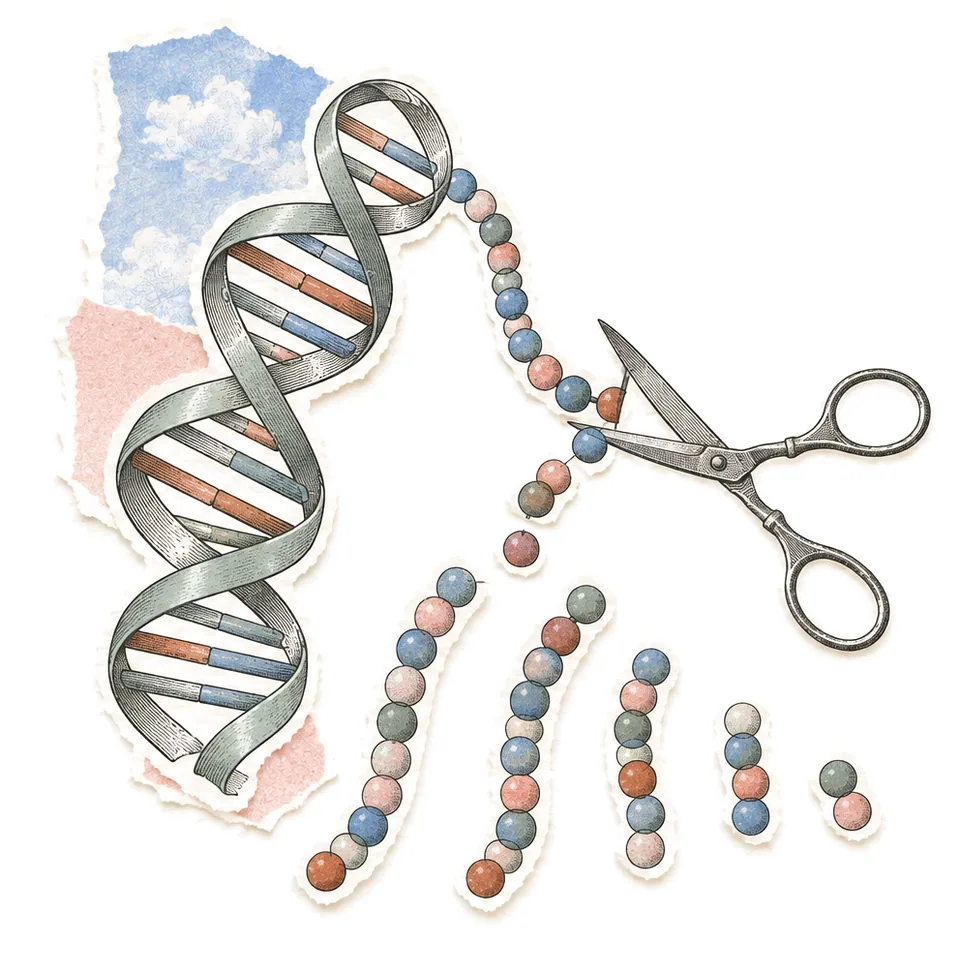
With two fixed backbones (a bidirectional Mamba and a Transformer), the pretraining data, a fixed nucleotide and compute budget and the downstream protocols fixed, design how DNA is turned into model tokens (vocabulary, learned segmentation, pretraining objective and the mapping back to nucleotides) so that the pretrained model transfers best across genomic tasks on either backbone.
DNA is a four-letter string with nothing to mark where one unit ends and signal at many scales, so a genomic model must decide what counts as a token: single nucleotides, k-mers or learned segments. Each choice trades resolution against sequence length, and comparisons find the best one depends on the task. It matters because the tokenizer decides what a genomic language model can resolve and how far it can see.
kuleshov-group/caduceusThe methods that compete on this question, each re-implemented in the task's code and measured under one protocol, the strongest first. Open one for its citation.
Qiao et al., 2024. Model Decides How to Tokenize: Adaptive DNA Sequence Tokenization with MxDNA. Advances in Neural Information Processing Systems.
The implementation comes with the benchmark's release.
Kim et al., 2026. DNACHUNKER: Learnable Tokenization for DNA Language Models. arXiv preprint.
The implementation comes with the benchmark's release.
Kim et al., 2026. DNACHUNKER: Learnable Tokenization for DNA Language Models. arXiv preprint.
The implementation comes with the benchmark's release.
Ji et al., 2021. DNABERT: pre-trained Bidirectional Encoder Representations from Transformers model for DNA-language in genome. Bioinformatics.
The implementation comes with the benchmark's release.
Dalla-Torre et al., 2024. Nucleotide Transformer: building and evaluating robust foundation models for human genomics. Nature Methods.
The implementation comes with the benchmark's release.
Shah et al., 2026. dnaHNet: A Scalable and Hierarchical Foundation Model for Genomic Sequence Learning. arXiv preprint.
Hwang et al., 2026. Dynamic Chunking for End-to-End Hierarchical Sequence Modeling. International Conference on Learning Representations.
The implementation comes with the benchmark's release.
Zhou et al., 2024. DNABERT-2: Efficient Foundation Model and Benchmark For Multi-Species Genomes. International Conference on Learning Representations.
The implementation comes with the benchmark's release.
Schiff et al., 2024. Caduceus: Bi-Directional Equivariant Long-Range DNA Sequence Modeling. Proceedings of the 41st International Conference on Machine Learning.
Nguyen et al., 2023. HyenaDNA: Long-Range Genomic Sequence Modeling at Single Nucleotide Resolution. Advances in Neural Information Processing Systems.
The implementation comes with the benchmark's release.
The implementation comes with the benchmark's release.
A method writes the tokenizer: the vocabulary, any segmentation network trained with the backbone, the pretraining objective and the mapping from backbone outputs back to one representation per nucleotide. The two backbones, the human-genome pretraining data, the nucleotide and compute budgets and the downstream heads and protocols are held fixed.
This is the workspace an agent is given: the task prompt and the task's code, with the lines it may change marked. Its submission is the code it leaves in those lines.
Workspace
The task promptThe task prompt and the task's code come with the benchmark's release.
Each tokenizer pretrained separately on each backbone; NT = mean MCC over the NT benchmark's 18 tasks; BEND = chance-normalised mean over gene finding, chromatin accessibility, histone modification, CpG methylation, enhancer annotation and variant effects (expression, disease).
Every method of the task, best first, with its task score out of 100.
Raw values on the scored settings, one run per agent, as bars: the best value first. Each chart says which direction is better.
The benchmark-level result of the setting: the mean MCC over the NT benchmark's 18 tasks, or the mean chance-normalised skill over the BEND tasks.
The bars start at 0.569, not at zero. A bar with a notched end runs beyond the chart; its number is exact.
| Method | ① | ② | ③ | ④ |
|---|---|---|---|---|
| Claude Fable 5.2 | 0.666 | 0.516 | 0.652 | 0.513 |
| GPT-6.2 Astra | 0.639 | 0.520 | 0.650 | 0.518 |
| Gemini 4 Carbon | 0.653 | 0.501 | 0.639 | 0.505 |
| Claude Opus 5.5 | 0.626 | 0.493 | 0.659 | 0.506 |
| Kimi K3.1 Pro | 0.629 | 0.480 | 0.631 | 0.480 |
| MxDNA | 0.650 | 0.468 | 0.639 | 0.438 |
| DNAChunker, camera-ready decoder | 0.628 | 0.465 | 0.629 | 0.462 |
| DNAChunker | 0.629 | 0.466 | 0.624 | 0.457 |
| Overlapping 6-mers | 0.598 | 0.474 | 0.635 | 0.468 |
| Muse Wonder Full | 0.608 | 0.464 | 0.623 | 0.474 |
| Qwen4-Max | 0.634 | 0.471 | 0.622 | 0.430 |
| Single-nucleotide tokens | 0.621 | 0.457 | 0.626 | 0.454 |
| Non-overlapping 6-mers | 0.594 | 0.445 | 0.611 | 0.434 |
| dnaHNet | 0.606 | 0.443 | 0.599 | 0.412 |
| Byte-pair encoding | 0.564 | 0.437 | 0.567 | 0.429 |
| No pretraining | 0.623 | 0.399 | 0.409 | 0.292 |
One run per model.
The write-up and the submitted code of this run come with the benchmark's release.
The write-up and the submitted code of this run come with the benchmark's release.
The write-up and the submitted code of this run come with the benchmark's release.
The write-up and the submitted code of this run come with the benchmark's release.
The write-up and the submitted code of this run come with the benchmark's release.
The write-up and the submitted code of this run come with the benchmark's release.
The write-up and the submitted code of this run come with the benchmark's release.