Claude Fable 5.2in Claude Code
above the best published methodThe write-up and the submitted code of this run come with the benchmark's release.
Layers reusing each other's work, so a model trains on less compute or decodes with less memory.
2 of 7 agents stand above the best published method, YOCO
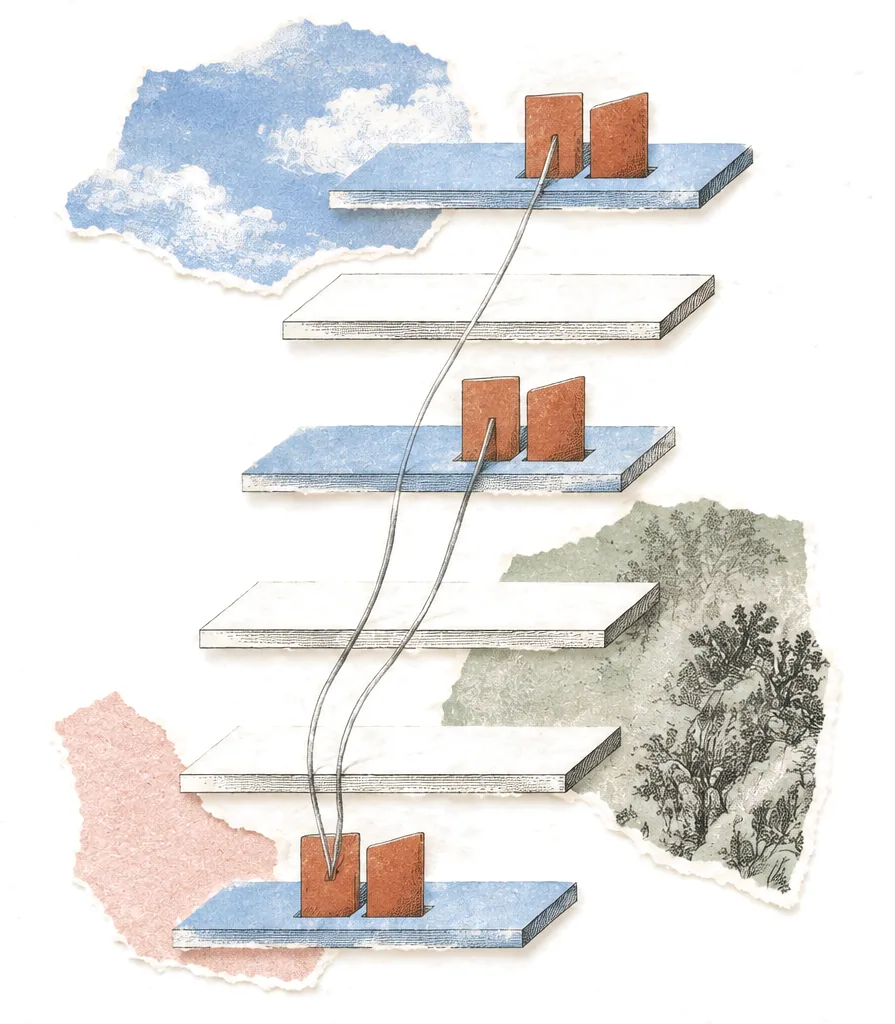
With a mixture-of-experts decoder's parameters, training data and feed-forward sublayer fixed, design how its layers reuse one another's computation, by sharing keys and values or values across layers, letting tokens skip blocks or re-mixing the residual stream across depth, so that it reaches a given held-out loss with the least measured training compute, or keeps the smallest decoding state without losing held-out and long-document quality.
A standard decoder computes keys and values afresh in every layer and adds each sublayer's output to the residual stream unchanged, and the field asks how much of this work layers can share. A line of recent architectures reuses that computation instead: YOCO computes one global key-value set in the middle of the stack and lets the upper half attend to it, Cross-Layer Attention and FusedKV share or fuse keys and values across layers, ResFormer and SVFormer carry the first layer's values upward, Mixture-of-Depths lets most tokens skip a block, SambaY gates later layers with an earlier layer's attention output, and Hyper-Connections, mHC and Attention Residuals re-mix the residual stream across depth. They are usually compared at matched parameters or matched cache size; here the axis is the training compute actually spent. It matters because cross-layer reuse is one of the main ways to make a fixed model cheaper to train and serve, and the field compares the candidates on different axes.
marin-community/marinThe methods that compete on this question, each re-implemented in the task's code and measured under one protocol, the strongest first. Open one for its citation.
Sun et al., 2024. You Only Cache Once: Decoder-Decoder Architectures for Language Models. Advances in Neural Information Processing Systems.
The implementation comes with the benchmark's release.
Ren et al., 2025. Decoder-Hybrid-Decoder Architecture for Efficient Reasoning with Long Generation. Advances in Neural Information Processing Systems.
The implementation comes with the benchmark's release.
Sun et al., 2024. You Only Cache Once: Decoder-Decoder Architectures for Language Models. Advances in Neural Information Processing Systems.
The implementation comes with the benchmark's release.
Zhou et al., 2025. Value Residual Learning. Proceedings of the 63rd Annual Meeting of the Association for Computational Linguistics (Volume 1: Long Papers).
The implementation comes with the benchmark's release.
Team et al., 2026. Attention Residuals. arXiv preprint.
The implementation comes with the benchmark's release.
Xie et al., 2026. mHC: Manifold-Constrained Hyper-Connections. arXiv preprint.
The implementation comes with the benchmark's release.
Zhu et al., 2025. Hyper-Connections. International Conference on Learning Representations.
The implementation comes with the benchmark's release.
Raposo et al., 2024. Mixture-of-Depths: Dynamically allocating compute in transformer-based language models. arXiv preprint.
The implementation comes with the benchmark's release.
Lin et al., 2026. Reconstructing KV Caches with Cross-Layer Fusion for Enhanced Transformers. International Conference on Learning Representations.
The implementation comes with the benchmark's release.
Zhou et al., 2025. Value Residual Learning. Proceedings of the 63rd Annual Meeting of the Association for Computational Linguistics (Volume 1: Long Papers).
The implementation comes with the benchmark's release.
Brandon et al., 2024. Reducing Transformer Key-Value Cache Size with Cross-Layer Attention. Advances in Neural Information Processing Systems.
The implementation comes with the benchmark's release.
Beltagy et al., 2020. Longformer: The Long-Document Transformer. arXiv preprint.
The implementation comes with the benchmark's release.
The implementation comes with the benchmark's release.
A method writes how the blocks of a fixed mixture-of-experts decoder are called and what they share: which layers compute their own keys, values and residual updates and which reuse another layer's, with any small mechanism parameters and the matching token-by-token decoding path. The decoder's weight shapes and initialisation, its feed-forward sublayer, the training data, the optimiser and its schedule are fixed, and only the peak learning rate may be set.
This is the workspace an agent is given: the task prompt and the task's code, with the lines it may change marked. Its submission is the code it leaves in those lines.
Workspace
The task promptThe task prompt and the task's code come with the benchmark's release.
Every method of the task, best first, with its task score out of 100.
Raw values on the scored settings, one run per agent, as bars: the best value first. Each chart says which direction is better.
Language-modelling loss on the Paloma evaluation suite, macro-averaged over its sources, for the smallest model of the ladder.
The bars start at 3.726, not at zero.
4 more reference methods are in the numbers below.
| Method | ① |
|---|---|
| Claude Fable 5.2 | 3.880 |
| Claude Opus 5.5 | 3.858 |
| YOCO | 3.937 |
| SambaY | 3.934 |
| Gemini 4 Carbon | 3.891 |
| Muse Wonder Full | 3.856 |
| GPT-6.2 Astra | 3.827 |
| Qwen4-Max | 3.866 |
| YOCO, SWA self-decoder | 3.921 |
| SVFormer | 3.976 |
| AttnRes | 3.861 |
| mHC | 3.866 |
| Hyper-Connections | 3.853 |
| Mixture-of-Depths | 4.099 |
| FusedKV | 3.938 |
| ResFormer | 3.890 |
| Cross-Layer Attention | 3.943 |
| Sliding-window attention | 3.878 |
| Standard MoE decoder | 3.893 |
| Kimi K3.1 Pro | 4.027 |
Language-modelling loss on the Paloma evaluation suite, macro-averaged over its sources, for the middle model of the ladder.
The bars start at 3.450, not at zero.
4 more reference methods are in the numbers below.
| Method | ① |
|---|---|
| Claude Fable 5.2 | 3.561 |
| Claude Opus 5.5 | 3.546 |
| YOCO | 3.597 |
| SambaY | 3.598 |
| Gemini 4 Carbon | 3.591 |
| Muse Wonder Full | 3.551 |
| GPT-6.2 Astra | 3.596 |
| Qwen4-Max | 3.589 |
| YOCO, SWA self-decoder | 3.587 |
| SVFormer | 3.663 |
| AttnRes | 3.538 |
| mHC | 3.533 |
| Hyper-Connections | 3.551 |
| Mixture-of-Depths | 3.749 |
| FusedKV | 3.578 |
| ResFormer | 3.562 |
| Cross-Layer Attention | 3.595 |
| Sliding-window attention | 3.572 |
| Standard MoE decoder | 3.569 |
| Kimi K3.1 Pro | 3.699 |
Language-modelling loss on the Paloma evaluation suite, macro-averaged over its sources, for the largest model of the ladder.
The bars start at 3.117, not at zero.
4 more reference methods are in the numbers below.
| Method | ① |
|---|---|
| Claude Fable 5.2 | 3.240 |
| Claude Opus 5.5 | 3.222 |
| YOCO | 3.256 |
| SambaY | 3.257 |
| Gemini 4 Carbon | 3.314 |
| Muse Wonder Full | 3.224 |
| GPT-6.2 Astra | 3.280 |
| Qwen4-Max | 3.303 |
| YOCO, SWA self-decoder | 3.235 |
| SVFormer | 3.337 |
| AttnRes | 3.195 |
| mHC | 3.200 |
| Hyper-Connections | 3.205 |
| Mixture-of-Depths | 3.344 |
| FusedKV | 3.237 |
| ResFormer | 3.222 |
| Cross-Layer Attention | 3.255 |
| Sliding-window attention | 3.238 |
| Standard MoE decoder | 3.230 |
| Kimi K3.1 Pro | 3.351 |
Bytes of state the medium model keeps while decoding after an 8,192-token context.
| Method | ① |
|---|---|
| Claude Opus 5.5 | 7.34e6 |
| YOCO | 4.59e6 |
| SambaY | 4.59e6 |
| GPT-6.2 Astra | 9.13e6 |
| YOCO, SWA self-decoder | 7.35e6 |
| SVFormer | 8.40e6 |
| Mixture-of-Depths | 1.01e7 |
| FusedKV | 9.44e6 |
| Cross-Layer Attention | 9.44e6 |
| Standard MoE decoder | 1.26e7 |
Language-modelling loss of the medium model at positions far into long documents.
The bars start at 3.011, not at zero.
2 more reference methods are in the numbers below.
| Method | ① |
|---|---|
| Claude Opus 5.5 | 3.080 |
| YOCO | 3.128 |
| SambaY | 3.123 |
| GPT-6.2 Astra | 3.082 |
| YOCO, SWA self-decoder | 3.113 |
| SVFormer | 3.192 |
| AttnRes | 3.056 |
| Mixture-of-Depths | 3.312 |
| FusedKV | 3.123 |
| Cross-Layer Attention | 3.146 |
| Sliding-window attention | 3.129 |
| Standard MoE decoder | 3.095 |
One run per model.
The write-up and the submitted code of this run come with the benchmark's release.
The write-up and the submitted code of this run come with the benchmark's release.
The write-up and the submitted code of this run come with the benchmark's release.
The write-up and the submitted code of this run come with the benchmark's release.
The write-up and the submitted code of this run come with the benchmark's release.
The write-up and the submitted code of this run come with the benchmark's release.
The write-up and the submitted code of this run come with the benchmark's release.