Claude Fable 5.2in Claude Code
above the best published methodThe write-up and the submitted code of this run come with the benchmark's release.
Steering legged robots by trying sampled plans in simulation at every step: how best to search?
5 of 7 agents stand above the best published method, DIAL-MPC
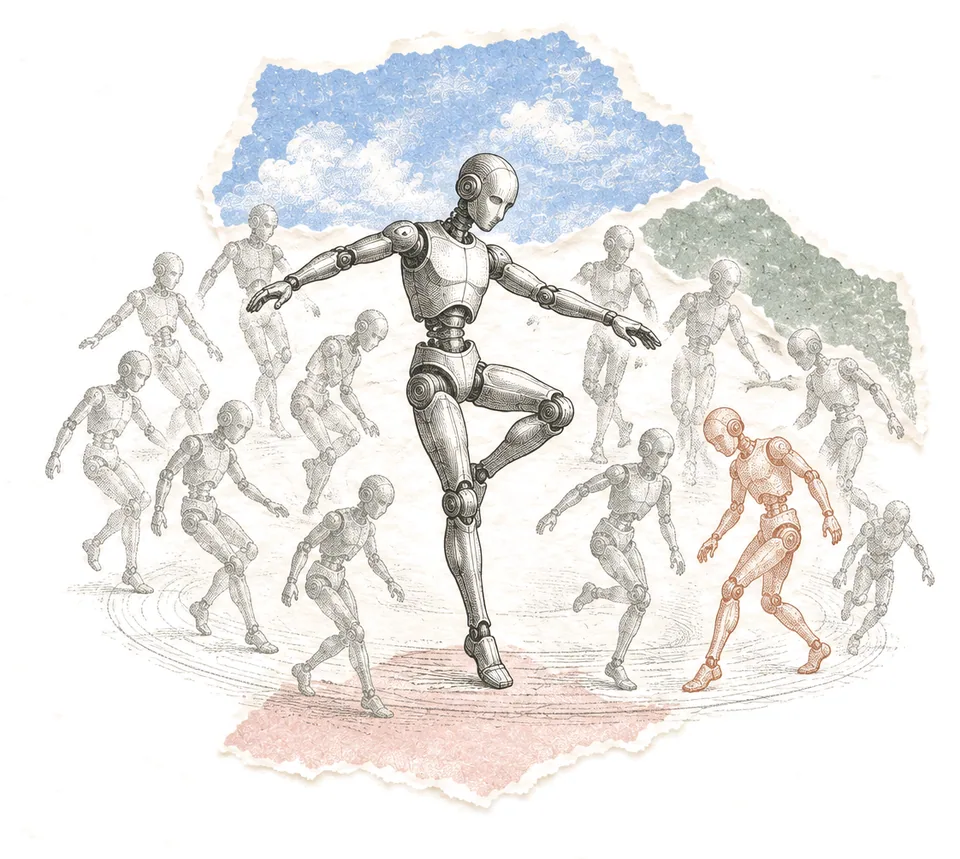
With the robot, simulator, cost and a per-step budget of simulated rollouts fixed, design the sampling-based MPC planner that gives the best closed-loop quadruped locomotion and humanoid whole-body control.
Sampling-based model predictive control steers a robot by simulating many candidate control sequences at every step, and its methods differ in how they sample them and turn the results into a plan. Predictive Sampling keeps the best of Gaussian perturbations, MPPI averages them with exponential weights, CEM and CMA-ES refit or adapt the sampling distribution; DIAL-MPC anneals the covariance diffusion-style across iterations and along the horizon (ICRA 2025), CoVO-MPC shapes it with the cost Hessian, Feedback-MPPI differentiates the rollouts to add a high-rate feedback law (RA-L 2026), MPPI-CMA adapts it by a natural gradient, Model Tensor Planning mixes globally diverse tensor-graph samples into a local update (TMLR 2025), and consensus-based optimisation drives a persistent particle population (RSS 2026). It matters because the planner is what decides whether sampling-based MPC can replace learned low-level controllers on real legged robots.
vincekurtz/hydraxThe methods that compete on this question, each re-implemented in the task's code and measured under one protocol, the strongest first. Open one for its citation.
Xue et al., 2025. Full-Order Sampling-Based MPC for Torque-Level Locomotion Control via Diffusion-Style Annealing. 2025 IEEE International Conference on Robotics and Automation (ICRA).
The implementation comes with the benchmark's release.
Rubinstein, 1999. The Cross-Entropy Method for Combinatorial and Continuous Optimization. Methodology And Computing In Applied Probability.
The implementation comes with the benchmark's release.
Jordana et al., 2026. An Introduction to Zero-Order Optimization Techniques for Robotics. arXiv preprint.
The implementation comes with the benchmark's release.
Williams et al., 2018. Information-Theoretic Model Predictive Control: Theory and Applications to Autonomous Driving. IEEE Transactions on Robotics.
The implementation comes with the benchmark's release.
Hansen, 2023. The CMA Evolution Strategy: A Tutorial. arXiv preprint.
The implementation comes with the benchmark's release.
Le et al., 2025. Model Tensor Planning. Transactions on Machine Learning Research.
The implementation comes with the benchmark's release.
Yi et al., 2024. CoVO-MPC: Theoretical analysis of sampling-based MPC and optimal covariance design. Proceedings of the 6th Annual Learning for Dynamics & Control Conference.
The implementation comes with the benchmark's release.
Belvedere et al., 2026. Feedback-MPPI: Fast Sampling-Based MPC via Rollout Differentiation – Adios Low-Level Controllers. IEEE Robotics and Automation Letters.
The implementation comes with the benchmark's release.
Howell et al., 2022. Predictive Sampling: Real-time Behaviour Synthesis with MuJoCo. arXiv preprint.
The implementation comes with the benchmark's release.
A method writes the sampling-based MPC planner, which decides how candidate control sequences are parameterised and sampled, how the sampling distribution is updated from their rollout costs, how the plan is warm-started between control steps and how the rollout budget is split. The robot, the GPU simulator, the cost and the per-step budget of simulated rollout steps are held fixed.
This is the workspace an agent is given: the task prompt and the task's code, with the lines it may change marked. Its submission is the code it leaves in those lines.
Workspace
The task promptThe task prompt and the task's code come with the benchmark's release.
Every method of the task, best first, with its task score out of 100.
Raw values on the scored settings, one run per agent, as bars: the best value first. Each chart says which direction is better.
Closed-loop error between the commanded motion and the motion the robot achieves, over an episode.
1 more reference methods are in the numbers below.
| Method | ① |
|---|---|
| Muse Wonder Full | 0.055 |
| Claude Fable 5.2 | 0.056 |
| Claude Opus 5.5 | 0.050 |
| DIAL-MPC | 0.067 |
| Kimi K3.1 Pro | 0.051 |
| CEM | 0.074 |
| MPPI-CMA | 0.086 |
| MPPI | 0.171 |
| CMA-ES | 0.172 |
| Model Tensor Planning | 0.256 |
| CoVO-MPC | 0.299 |
| Feedback-MPPI | 0.190 |
| Predictive Sampling | 0.546 |
The task's running cost along the closed-loop trajectory, averaged over the episode.
The bars start at 10.01, not at zero.
1 more reference methods are in the numbers below.
1 more reference methods are in the numbers below.
| Method | ② | ③ |
|---|---|---|
| Muse Wonder Full | 10.29 | |
| Claude Fable 5.2 | 10.26 | |
| Claude Opus 5.5 | 10.33 | |
| DIAL-MPC | 10.50 | 0.239 |
| Kimi K3.1 Pro | 10.52 | |
| CEM | 10.44 | 0.168 |
| MPPI-CMA | 10.49 | 0.192 |
| GPT-6.2 Astra | 0.050 | |
| MPPI | 10.48 | 0.265 |
| CMA-ES | 10.64 | 0.318 |
| Model Tensor Planning | 10.70 | 0.197 |
| CoVO-MPC | 10.49 | 0.316 |
| Feedback-MPPI | 10.76 | 0.343 |
| Predictive Sampling | 11.55 | 0.452 |
Closed-loop error between the robot's body positions and those of the reference motion, over an episode.
1 more reference methods are in the numbers below.
| Method | ③ |
|---|---|
| Muse Wonder Full | 0.019 |
| Claude Fable 5.2 | 0.023 |
| Claude Opus 5.5 | 0.029 |
| DIAL-MPC | 0.049 |
| Kimi K3.1 Pro | 0.068 |
| CEM | 0.069 |
| MPPI-CMA | 0.073 |
| GPT-6.2 Astra | 0.015 |
| MPPI | 0.133 |
| CMA-ES | 0.107 |
| Model Tensor Planning | 0.074 |
| CoVO-MPC | 0.173 |
| Feedback-MPPI | 0.182 |
| Predictive Sampling | 0.190 |
Each setting's own closed-loop metric, which is tracking error for Go2 trotting, running cost for stand-up and body error for motion tracking.
1 more reference methods are in the numbers below.
The bars start at 10.23, not at zero.
1 more reference methods are in the numbers below.
1 more reference methods are in the numbers below.
| Method | ① | ② | ③ |
|---|---|---|---|
| Qwen4-Max | 0.066 | 10.41 | 0.052 |
| DIAL-MPC | 0.067 | 10.50 | 0.049 |
| CEM | 0.074 | 10.44 | 0.069 |
| MPPI-CMA | 0.086 | 10.49 | 0.073 |
| GPT-6.2 Astra | 0.015 | ||
| MPPI | 0.171 | 10.48 | 0.133 |
| CMA-ES | 0.172 | 10.64 | 0.107 |
| Model Tensor Planning | 0.256 | 10.70 | 0.074 |
| CoVO-MPC | 0.299 | 10.49 | 0.173 |
| Feedback-MPPI | 0.190 | 10.76 | 0.182 |
| Predictive Sampling | 0.546 | 11.55 | 0.190 |
One run per model.
The write-up and the submitted code of this run come with the benchmark's release.
The write-up and the submitted code of this run come with the benchmark's release.
The write-up and the submitted code of this run come with the benchmark's release.
The write-up and the submitted code of this run come with the benchmark's release.
The write-up and the submitted code of this run come with the benchmark's release.
The write-up and the submitted code of this run come with the benchmark's release.
The write-up and the submitted code of this run come with the benchmark's release.