Claude Fable 5.2in Claude Code
above the best published methodThe write-up and the submitted code of this run come with the benchmark's release.
Can a neural flow solver get airflow, lift and drag right at speeds and angles beyond its training?
6 of 7 agents stand above the best published method, AB-UPT
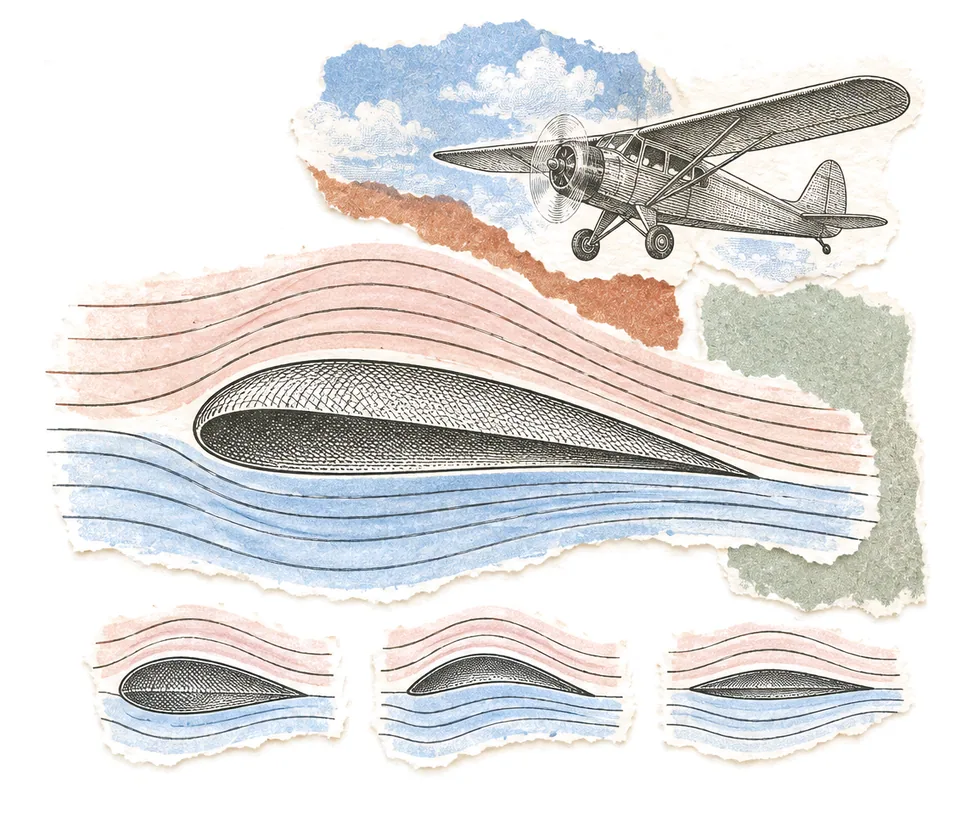
With the CFD data (AirfRANS's 2D airfoil RANS solutions and NASA-CRM's 3D aircraft surface solutions), their splits and the training budget fixed, design the neural operator (architecture, conditioning on the freestream state, representation, objective or inference) whose predicted fields and integrated lift and drag stay accurate at Reynolds numbers, angles of attack and Mach numbers outside the training range, without losing accuracy in distribution.
Aerodynamic design asks a neural surrogate to predict steady flow around a new shape at the conditions an engineer cares about, which are often outside the range it was trained on. Published neural operators -- point networks, graph networks, physics-attention transformers (Transolver, Transolver++, LinearNO, LRSA), hierarchical ball-tree attention (Erwin), geometry-aware attention (GeoTransolver), PDE-conditional blocks (Unisolver), anchored-branched transformers (AB-UPT), and the ML4CFD 2024 competition solutions GeoMPNN, OB-GNN and MARIO -- degrade sharply out of range: field errors grow several-fold and the integrated forces, especially skin-friction-dominated drag, are poorly predicted. It matters because a surrogate is only useful in a design loop if its forces stay right where the designer is looking.
thuml/Neural-Solver-LibraryThe methods that compete on this question, each re-implemented in the task's code and measured under one protocol, the strongest first. Open one for its citation.
Alkin et al., 2025. AB-UPT: Scaling Neural CFD Surrogates for High- Fidelity Automotive Aerodynamics Simulations via Anchored- Branched Universal Physics Transformers. Transactions on Machine Learning Research.
The implementation comes with the benchmark's release.
Yagoubi et al., 2025. ML4CFD Competition: Results and Retrospective Analysis. Advances in Neural Information Processing Systems 38.
The implementation comes with the benchmark's release.
Zhou et al., 2025. Unisolver: PDE-Conditional Transformers Towards Universal Neural PDE Solvers. Proceedings of the 42nd International Conference on Machine Learning.
The implementation comes with the benchmark's release.
Hu et al., 2026. Transolver Is a Linear Transformer: Revisiting Physics-Attention Through the Lens of Linear Attention. Proceedings of the AAAI Conference on Artificial Intelligence.
The implementation comes with the benchmark's release.
Wu et al., 2024. Transolver: A Fast Transformer Solver for PDEs on General Geometries. Proceedings of the 41st International Conference on Machine Learning.
The implementation comes with the benchmark's release.
Luo et al., 2025. Transolver++: An Accurate Neural Solver for PDEs on Million-Scale Geometries. Proceedings of the 42nd International Conference on Machine Learning.
The implementation comes with the benchmark's release.
Adams et al., 2026. GeoTransolver: Learning Physics on Irregular Domains Using Multi-scale Geometry Aware Physics Attention Transformer. arXiv preprint.
The implementation comes with the benchmark's release.
Zhdanov et al., 2025. Erwin: A Tree-based Hierarchical Transformer for Large-scale Physical Systems. Proceedings of the 42nd International Conference on Machine Learning.
The implementation comes with the benchmark's release.
Yang et al., 2026. Simple yet Effective: Low-Rank Spatial Attention for Neural Operators. Proceedings of the 43rd International Conference on Machine Learning.
The implementation comes with the benchmark's release.
Hamilton et al., 2017. Inductive Representation Learning on Large Graphs. Advances in Neural Information Processing Systems.
The implementation comes with the benchmark's release.
Catalani et al., 2025. Towards scalable surrogate models based on Neural Fields for large scale aerodynamic simulations. arXiv preprint.
The implementation comes with the benchmark's release.
Qi et al., 2017. PointNet: Deep Learning on Point Sets for 3D Classification and Segmentation. Proceedings of the IEEE Conference on Computer Vision and Pattern Recognition (CVPR).
The implementation comes with the benchmark's release.
Helwig et al., 2024. A Geometry-Aware Message Passing Neural Network for Modeling Aerodynamics over Airfoils. arXiv preprint.
The implementation comes with the benchmark's release.
A method writes the neural operator that maps each mesh node's coordinates and input features, among them the freestream state, wall distance and wall normals, to the flow fields, and it may also set its own loss, training-node sampling, optimiser and whole-mesh inference. The CFD datasets, their splits, the epoch budget and the integration of lift and drag from the predicted wall fields are held fixed.
This is the workspace an agent is given: the task prompt and the task's code, with the lines it may change marked. Its submission is the code it leaves in those lines.
Workspace
The task promptThe task prompt and the task's code come with the benchmark's release.
Every method of the task, best first, with its task score out of 100.
Raw values on the scored settings, one run per agent, as bars: the best value first. Each chart says which direction is better.
Mean relative error of the lift coefficient integrated from the predicted wall pressure and shear stress.
5 more reference methods are in the numbers below.
5 more reference methods are in the numbers below.
5 more reference methods are in the numbers below.
| Method | ① | ② | ③ |
|---|---|---|---|
| Claude Fable 5.2 | 0.004 | 0.025 | 0.008 |
| GPT-6.2 Astra | 0.003 | 0.008 | 0.005 |
| Claude Opus 5.5 | 0.010 | 0.047 | 0.016 |
| Muse Wonder Full | 0.005 | 0.054 | 0.009 |
| Kimi K3.1 Pro | 0.009 | 0.035 | 0.018 |
| AB-UPT | 0.012 | 0.044 | 0.055 |
| OB-GNN | 0.028 | 0.054 | 0.038 |
| Qwen4-Max | 0.029 | 0.246 | 0.054 |
| Unisolver | 0.025 | 0.126 | 0.071 |
| LinearNO | 0.023 | 0.140 | 0.117 |
| Transolver | 0.029 | 0.159 | 0.119 |
| Transolver++ | 0.030 | 0.152 | 0.094 |
| GeoTransolver | 0.028 | 0.116 | 0.166 |
| Erwin | 0.028 | 0.109 | 0.099 |
| LRSA | 0.018 | 0.288 | 0.079 |
| GraphSAGE | 0.038 | 0.373 | 0.232 |
| MARIO | 0.139 | 0.342 | 0.268 |
| PointNet | 0.052 | 0.211 | 0.121 |
| GeoMPNN | 0.034 | 0.200 | 0.096 |
Mean absolute error of the integrated lift coefficient.
4 more reference methods are in the numbers below.
| Method | ④ |
|---|---|
| Claude Fable 5.2 | 0.014 |
| GPT-6.2 Astra | 0.014 |
| Claude Opus 5.5 | 0.016 |
| Muse Wonder Full | 0.023 |
| Kimi K3.1 Pro | 0.026 |
| AB-UPT | 0.010 |
| OB-GNN | 0.074 |
| Qwen4-Max | 0.021 |
| Unisolver | 0.017 |
| LinearNO | 0.017 |
| Transolver | 0.023 |
| Transolver++ | 0.021 |
| GeoTransolver | 0.038 |
| Erwin | 0.026 |
| LRSA | 0.018 |
| GraphSAGE | 0.043 |
| MARIO | 0.037 |
| PointNet | 0.034 |
Mean absolute error of the integrated drag coefficient.
4 more reference methods are in the numbers below.
| Method | ④ |
|---|---|
| Claude Fable 5.2 | 28.50 |
| GPT-6.2 Astra | 37.21 |
| Claude Opus 5.5 | 20.15 |
| Muse Wonder Full | 28.83 |
| Kimi K3.1 Pro | 81.16 |
| AB-UPT | 18.67 |
| OB-GNN | 77.04 |
| Qwen4-Max | 60.32 |
| Unisolver | 41.58 |
| LinearNO | 23.43 |
| Transolver | 33.41 |
| Transolver++ | 33.92 |
| GeoTransolver | 40.73 |
| Erwin | 30.03 |
| LRSA | 28.72 |
| GraphSAGE | 49.68 |
| MARIO | 83.18 |
| PointNet | 59.28 |
Spearman rank correlation between predicted and true drag across the test cases.
5 more reference methods are in the numbers below.
4 more reference methods are in the numbers below.
5 more reference methods are in the numbers below.
The bars start at 0.810, not at zero. A bar with a notched end runs beyond the chart; its number is exact.
4 more reference methods are in the numbers below.
| Method | ① | ② | ③ | ④ |
|---|---|---|---|---|
| Claude Fable 5.2 | 0.999 | 0.973 | 0.998 | 0.926 |
| GPT-6.2 Astra | 0.999 | 0.976 | 0.997 | 0.936 |
| Claude Opus 5.5 | 0.988 | 0.882 | 0.975 | 0.947 |
| Muse Wonder Full | 0.988 | 0.885 | 0.952 | 0.949 |
| Kimi K3.1 Pro | 0.986 | 0.949 | 0.963 | 0.431 |
| AB-UPT | 0.871 | 0.602 | 0.761 | 0.958 |
| OB-GNN | 0.820 | 0.857 | 0.721 | 0.875 |
| Qwen4-Max | 0.950 | 0.690 | 0.902 | 0.859 |
| Unisolver | 0.825 | 0.726 | 0.439 | 0.908 |
| LinearNO | 0.918 | 0.672 | 0.283 | 0.946 |
| Transolver | 0.786 | 0.779 | 0.453 | 0.924 |
| Transolver++ | 0.761 | 0.811 | 0.238 | 0.927 |
| GeoTransolver | 0.508 | 0.740 | 0.522 | 0.918 |
| Erwin | 0.689 | 0.691 | 0.493 | 0.958 |
| LRSA | 0.715 | 0.869 | 0.341 | 0.945 |
| GraphSAGE | 0.738 | 0.705 | 0.239 | 0.885 |
| MARIO | 0.635 | 0.730 | 0.382 | 0.784 |
| PointNet | 0.295 | 0.193 | -0.025 | 0.874 |
| GeoMPNN | 0.785 | 0.754 | 0.701 |
Mean squared error of the predicted flow fields at the volume nodes.
5 more reference methods are in the numbers below.
A bar with a notched end runs beyond the chart; its number is exact.
5 more reference methods are in the numbers below.
5 more reference methods are in the numbers below.
| Method | ① | ② | ③ |
|---|---|---|---|
| Claude Fable 5.2 | 0.057 | ||
| GPT-6.2 Astra | 3.33e-4 | 0.060 | 0.003 |
| Claude Opus 5.5 | 0.082 | ||
| Muse Wonder Full | 0.074 | ||
| Kimi K3.1 Pro | 0.066 | ||
| AB-UPT | 3.35e-4 | 0.078 | 0.004 |
| OB-GNN | 0.004 | 0.102 | 0.011 |
| Qwen4-Max | 0.470 | ||
| Unisolver | 0.001 | 0.152 | 0.012 |
| LinearNO | 0.001 | 0.151 | 0.021 |
| Transolver | 0.001 | 0.132 | 0.013 |
| Transolver++ | 0.002 | 0.133 | 0.011 |
| GeoTransolver | 0.001 | 0.091 | 0.007 |
| Erwin | 0.003 | 0.105 | 0.017 |
| LRSA | 0.001 | 0.191 | 0.011 |
| GraphSAGE | 0.003 | 0.133 | 0.038 |
| MARIO | 0.002 | 0.089 | 0.009 |
| PointNet | 0.005 | 0.110 | 0.016 |
| GeoMPNN | 0.002 | 0.126 | 0.011 |
Mean squared error of the predicted flow fields at the wall nodes.
5 more reference methods are in the numbers below.
5 more reference methods are in the numbers below.
5 more reference methods are in the numbers below.
| Method | ① | ② | ③ |
|---|---|---|---|
| Claude Fable 5.2 | 0.004 | ||
| GPT-6.2 Astra | 2.10e-5 | 0.004 | 6.00e-4 |
| Claude Opus 5.5 | 0.006 | ||
| Muse Wonder Full | 0.010 | ||
| Kimi K3.1 Pro | 0.005 | ||
| AB-UPT | 4.00e-5 | 0.026 | 0.001 |
| OB-GNN | 1.37e-4 | 0.011 | 0.001 |
| Qwen4-Max | 0.082 | ||
| Unisolver | 3.87e-4 | 0.049 | 0.004 |
| LinearNO | 7.75e-4 | 0.060 | 0.009 |
| Transolver | 8.97e-4 | 0.074 | 0.011 |
| Transolver++ | 8.48e-4 | 0.078 | 0.010 |
| GeoTransolver | 0.001 | 0.060 | 0.006 |
| Erwin | 0.001 | 0.031 | 0.010 |
| LRSA | 0.001 | 0.090 | 0.010 |
| GraphSAGE | 7.88e-4 | 0.042 | 0.022 |
| MARIO | 0.001 | 0.015 | 0.005 |
| PointNet | 0.001 | 0.037 | 0.007 |
| GeoMPNN | 0.002 | 0.053 | 0.009 |
Relative L2 error of the predicted surface pressure coefficient.
A bar with a notched end runs beyond the chart; its number is exact.
4 more reference methods are in the numbers below.
| Method | ④ |
|---|---|
| Claude Fable 5.2 | 0.146 |
| GPT-6.2 Astra | 0.195 |
| Claude Opus 5.5 | 0.140 |
| Muse Wonder Full | 0.167 |
| Kimi K3.1 Pro | 0.253 |
| AB-UPT | 0.128 |
| OB-GNN | 0.436 |
| Qwen4-Max | 0.230 |
| Unisolver | 0.157 |
| LinearNO | 0.155 |
| Transolver | 0.162 |
| Transolver++ | 0.158 |
| GeoTransolver | 0.157 |
| Erwin | 0.161 |
| LRSA | 0.153 |
| GraphSAGE | 0.209 |
| MARIO | 0.313 |
| PointNet | 0.318 |
One run per model.
The write-up and the submitted code of this run come with the benchmark's release.
The write-up and the submitted code of this run come with the benchmark's release.
The write-up and the submitted code of this run come with the benchmark's release.
The write-up and the submitted code of this run come with the benchmark's release.
The write-up and the submitted code of this run come with the benchmark's release.
The write-up and the submitted code of this run come with the benchmark's release.
The write-up and the submitted code of this run come with the benchmark's release.