Claude Fable 5.2in Claude Code
level with the best published methodThe write-up and the submitted code of this run come with the benchmark's release.
Many proteins have two shapes: can one model, trained once, find and name both in a new protein?
0 of 7 agents stand above the best published method, AFsample2
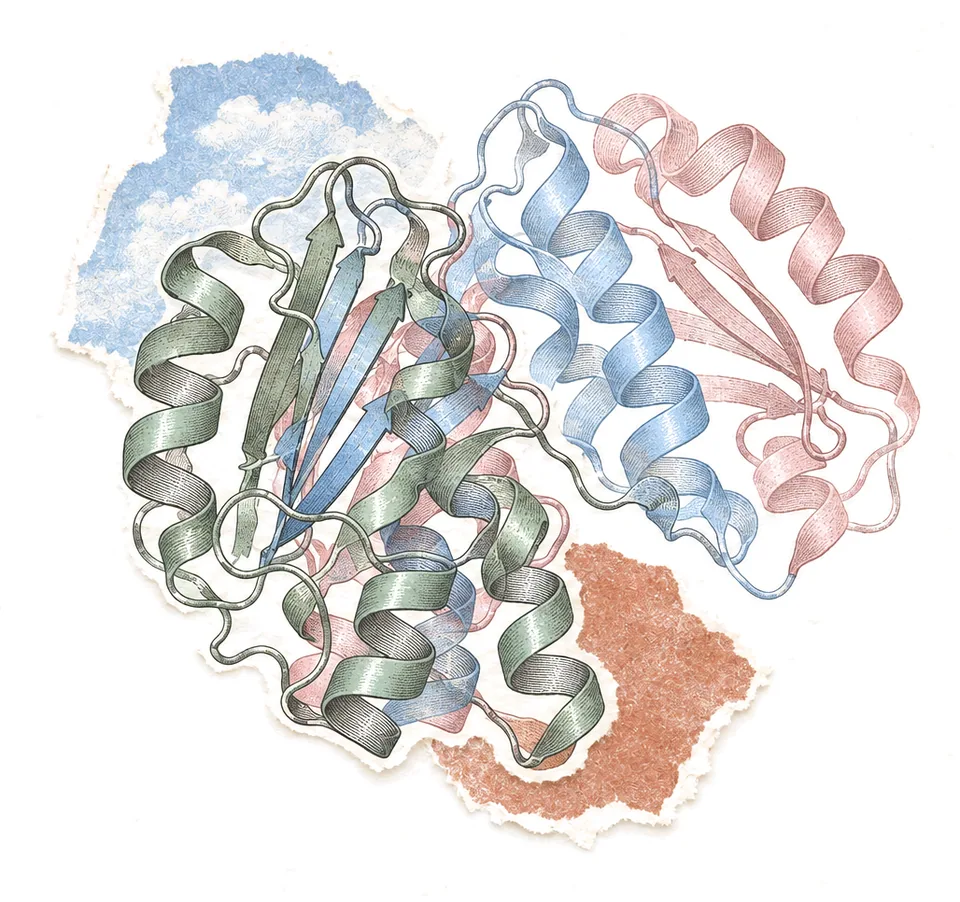
Train a method, once, on a corpus of experimental structures so that for a protein it has never seen it returns structures covering both of its observed states and nominates the two.
Proteins work by changing shape, so the field asks for models that return the set of states a protein adopts rather than one best structure, and that do so for proteins they were never trained on.
sokrypton/ColabFoldThe methods that compete on this question, each re-implemented in the task's code and measured under one protocol, the strongest first. Open one for its citation.
Kalakoti and Wallner, 2025. AFsample2 predicts multiple conformations and ensembles with AlphaFold2. Communications Biology.
The implementation comes with the benchmark's release.
Jing et al., 2024. AlphaFold Meets Flow Matching for Generating Protein Ensembles. Proceedings of the 41st International Conference on Machine Learning.
The implementation comes with the benchmark's release.
Lewis et al., 2025. Scalable emulation of protein equilibrium ensembles with generative deep learning. Science.
The implementation comes with the benchmark's release.
Jing et al., 2024. AlphaFold Meets Flow Matching for Generating Protein Ensembles. Proceedings of the 41st International Conference on Machine Learning.
The implementation comes with the benchmark's release.
Wayment-Steele et al., 2023. Predicting multiple conformations via sequence clustering and AlphaFold2. Nature.
The implementation comes with the benchmark's release.
Bryant and Noé, 2024. Structure prediction of alternative protein conformations. Nature Communications.
The implementation comes with the benchmark's release.
Cao et al., 2026. SF-Cluster: Frustration-Guided MSA Subsampling for Alternative Protein Conformation Recovery. arXiv preprint.
The implementation comes with the benchmark's release.
Jumper et al., 2021. Highly accurate protein structure prediction with AlphaFold. Nature.
The implementation comes with the benchmark's release.
The implementation comes with the benchmark's release.
Cao et al., 2026. SF-Cluster: Frustration-Guided MSA Subsampling for Alternative Protein Conformation Recovery. arXiv preprint.
The implementation comes with the benchmark's release.
The implementation comes with the benchmark's release.
A method writes one class with two phases: a training phase, run once on a corpus of experimental structures under a GPU-hour cap, and a per-protein phase that returns a ranked ensemble of structures and a nomination of the protein's two states. The structure corpus, the pretrained predictors and generators the method may call, and the GPU-time budget per protein stay fixed.
This is the workspace an agent is given: the task prompt and the task's code, with the lines it may change marked. Its submission is the code it leaves in those lines.
Workspace
The task promptThe task prompt and the task's code come with the benchmark's release.
Every method of the task, best first, with its task score out of 100.
Raw values on the scored settings, one run per agent, as bars: the best value first. Each chart says which direction is better.
How well the two nominated structures recover the protein's two observed states on the residues that switch, with the weaker state counting.
| Method | ① | ② |
|---|---|---|
| AFsample2 | 0.084 | 0.146 |
| Claude Fable 5.2 | 0.091 | 0.110 |
| Kimi K3.1 Pro | 0.074 | 0.048 |
| AlphaFlow | 0.053 | 0.125 |
| Claude Opus 5.5 | 0.066 | 0.060 |
| Muse Wonder Full | 0.062 | 0.074 |
| Gemini 4 Carbon | 0.053 | 0.091 |
| Qwen4-Max | 0.060 | 0.050 |
| GPT-6.2 Astra | 0.058 | 0.059 |
| BioEmu | 0.044 | 0.071 |
| Random MSA subsampling | 0.027 | 0.061 |
| ESMFlow | 0.033 | 0.009 |
| AF-Cluster | 0.022 | 0.034 |
| Elastic-network normal modes | 0.011 | 0.064 |
| Cfold | 0.008 | 0.038 |
| AlphaFold2, full MSA | 0.004 | 0.062 |
| Coarse-grained simulation | 0.006 | 0.046 |
One run per model.
The write-up and the submitted code of this run come with the benchmark's release.
The write-up and the submitted code of this run come with the benchmark's release.
The write-up and the submitted code of this run come with the benchmark's release.
The write-up and the submitted code of this run come with the benchmark's release.
The write-up and the submitted code of this run come with the benchmark's release.
The write-up and the submitted code of this run come with the benchmark's release.
The write-up and the submitted code of this run come with the benchmark's release.