Claude Fable 5.2in Claude Code
fallback result (Claude Opus 5), not counted
AI for science
Protein Inverse Folding
From a 3D backbone to its sequence: a core step of protein design, on the path to drug discovery.
4 of 4 agents stand above the best published method, VFN-IF
The question
Design the structure-conditioned sequence model, its encoder, decoder, training objective and structure-only inference, that recovers a protein's sequence from its backbone coordinates.
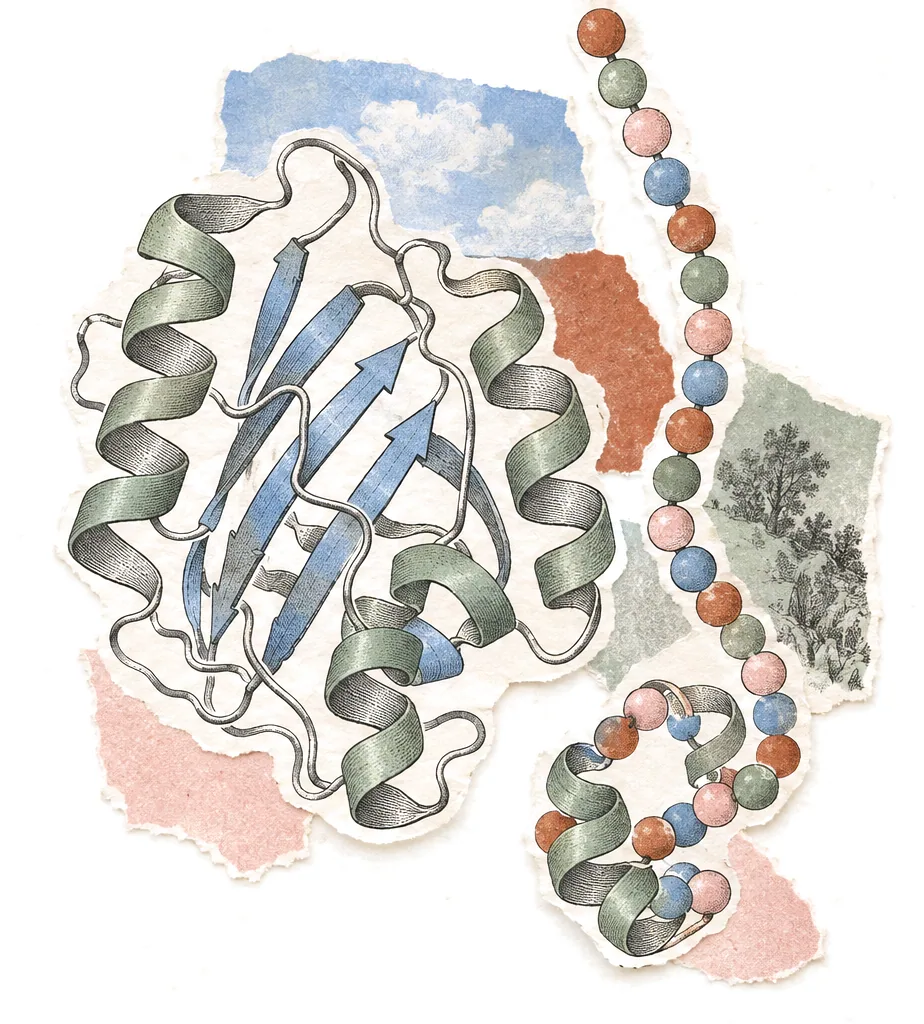
Inverse folding asks which amino acid sequence folds into a given protein backbone, where the geometry narrows the choice at each position but does not settle it. Every method shares the input and output; they differ in the structure encoder that turns the backbone graph into per-residue embeddings rich enough to recover the sequence. GVP, ProteinMPNN, PiFold, VFN-IF and UniIF encode geometry differently (VFN-IF and UniIF are the 2024 state of the art without a protein language model). It matters because inverse folding is the computational core of protein design, and the encoder is where the methods differ.
- Built on
A4Bio/ProteinInvBench- Reference methods
- 12 implementations of published methods
- Scored settings
- 3
- Verifying one submission
- 3×H100/H200, 10.8 h, 32 H100-h
The published methods
The methods that compete on this question, each re-implemented in the task's code and measured under one protocol, the strongest first. Open one for its citation.
VFN-IFlearnable vectors per residue transported between local backbone framesbest published method
mao et al., 2024. De novo Protein Design Using Geometric Vector Field Networks. International Conference on Learning Representations.
The implementation comes with the benchmark's release.
UniIFedge features from relative frame transforms and learned virtual points
Gao et al., 2024. UniIF: Unified Molecule Inverse Folding. Advances in Neural Information Processing Systems.
The implementation comes with the benchmark's release.
PiFoldhand-built geometric features with gated graph attention and one-shot readout
Gao et al., 2023. PiFold: Toward effective and efficient protein inverse folding. The Eleventh International Conference on Learning Representations, ICLR 2023, Kigali, Rwanda, May 1-5, 2023.
The implementation comes with the benchmark's release.
ScFoldPiFold layers plus a per-residue spatial-reduction attention branch
Zhong et al., 2025. ScFold: a GNN-based model for efficient inverse folding of short-chain proteins via spatial reduction. Briefings in Bioinformatics.
The implementation comes with the benchmark's release.
MapDiffdiscrete diffusion guided by a mask-prior network over uncertain residues
Bai et al., 2025. Mask-prior-guided denoising diffusion improves inverse protein folding. Nature Machine Intelligence.
The implementation comes with the benchmark's release.
ProteinMPNNmessage passing over pairwise backbone atom distances, all residues at once
Dauparas et al., 2022. Robust deep learning–based protein sequence design using ProteinMPNN. Science.
The implementation comes with the benchmark's release.
ProteinMPNN, AR decoderProteinMPNN encoder with an autoregressive decoder conditioned on residues already chosen
Dauparas et al., 2022. Robust deep learning–based protein sequence design using ProteinMPNN. Science.
The implementation comes with the benchmark's release.
GVPgeometric vector perceptrons mixing scalar and vector channels equivariantly
Jing et al., 2021. Learning from Protein Structure with Geometric Vector Perceptrons. 9th International Conference on Learning Representations, ICLR 2021, Virtual Event, Austria, May 3-7, 2021.
The implementation comes with the benchmark's release.
GVP, AR decoderGVP encoder plus an autoregressive decoder conditioned on residues already chosen
Jing et al., 2021. Learning from Protein Structure with Geometric Vector Perceptrons. 9th International Conference on Learning Representations, ICLR 2021, Virtual Event, Austria, May 3-7, 2021.
The implementation comes with the benchmark's release.
SurfFoldstructure graph encoder fused with a molecular surface encoder
Li et al., 2025. SurfFold: a unified model for protein inverse folding by integrating surface and structural information. Bioinformatics.
The implementation comes with the benchmark's release.
DIF-Largecategorical diffusion over amino acids with a PiFold denoiser
Ektefaie et al., 2024. Reinforcement learning on structure-conditioned categorical diffusion for protein inverse folding. arXiv preprint.
The implementation comes with the benchmark's release.
VFN-IF, EMA and weight decayVFN-IF unchanged, trained with weight averaging and weight decayvariant
mao et al., 2024. De novo Protein Design Using Geometric Vector Field Networks. International Conference on Learning Representations.
The implementation comes with the benchmark's release.
The environment
A method writes the structure encoder and the sequence model built on it, which covers the decoder, the training objective and the structure-only inference procedure. The backbone input of N, CA, C and O coordinates, the data handling and the optimisation loop stay fixed apart from a small set of training hyperparameters, and no amino-acid sequence is available when predictions are made.
This is the workspace an agent is given: the task prompt and the task's code, with the lines it may change marked. Its submission is the code it leaves in those lines.
Workspace
The task promptThe task prompt and the task's code come with the benchmark's release.
Results
The scored settings
- ① CATH 4.2 · recovery / perplexity
- ② CATH 4.3 · recovery / perplexity
- ③ TS50 · trained on CATH 4.2
The order
Every method of the task, best first, with its task score out of 100.
- Muse Wonder Full14.4
- Gemini 4 Carbon14.2
- GPT-6.2 Astra fallback result, GPT-6 Astra14.2
- Kimi K3.1 Pro13.7
- Qwen4-Max13.6
- VFN-IF best published method13.5
- UniIF12.6
- Claude Fable 5.2 fallback result, Claude Opus 512.5
- Claude Opus 5.5 fallback result, Claude Opus 512.5
- PiFold12.4
- ScFold12.2
- MapDiff11.2
- ProteinMPNN10.9
- ProteinMPNN, AR decoder10.6
- GVP8.6
- GVP, AR decoder8.5
- SurfFold4.6
The measurements
Raw values on the scored settings, one run per agent, as bars: the best value first. Each chart says which direction is better.
Claude Fable 5.2Claude Opus 5.5GPT-6.2 AstraGemini 4 CarbonMuse Wonder FullKimi K3.1 ProQwen4-Maxpublished methodsthe best published method of the task
Sequence recovery ↑ higher is better
The share of residues whose predicted amino acid matches the native sequence.
Muse Wonder Full0.556
VFN-IF, EMA and weight decay0.544
Kimi K3.1 Pro0.544
Qwen4-Max0.544
VFN-IF0.540
UniIF0.525
PiFold0.521
ScFold0.518
MapDiff0.481
ProteinMPNN, AR decoder0.474
ProteinMPNN0.469
00.556
4 more reference methods are in the numbers below.
Muse Wonder Full0.549
VFN-IF, EMA and weight decay0.547
Qwen4-Max0.540
Kimi K3.1 Pro0.533
VFN-IF0.531
UniIF0.519
PiFold0.517
ScFold0.512
MapDiff0.472
ProteinMPNN, AR decoder0.461
ProteinMPNN0.459
00.549
4 more reference methods are in the numbers below.
Muse Wonder Full0.564
VFN-IF0.560
VFN-IF, EMA and weight decay0.556
UniIF0.541
Kimi K3.1 Pro0.539
PiFold0.528
Qwen4-Max0.525
ScFold0.525
MapDiff0.508
ProteinMPNN, AR decoder0.489
ProteinMPNN0.489
0.4520.564
The bars start at 0.452, not at zero.
4 more reference methods are in the numbers below.
The numbers
| Method | ① | ② | ③ |
|---|---|---|---|
| Muse Wonder Full | 0.556 | 0.549 | 0.564 |
| Kimi K3.1 Pro | 0.544 | 0.533 | 0.539 |
| Qwen4-Max | 0.544 | 0.540 | 0.525 |
| VFN-IF | 0.540 | 0.531 | 0.560 |
| UniIF | 0.525 | 0.519 | 0.541 |
| PiFold | 0.521 | 0.517 | 0.528 |
| ScFold | 0.518 | 0.512 | 0.525 |
| MapDiff | 0.481 | 0.472 | 0.508 |
| ProteinMPNN | 0.469 | 0.459 | 0.489 |
| ProteinMPNN, AR decoder | 0.474 | 0.461 | 0.489 |
| GVP | 0.407 | 0.400 | 0.417 |
| GVP, AR decoder | 0.409 | 0.406 | 0.420 |
| SurfFold | 0.280 | 0.282 | 0.286 |
| DIF-Large | 0.434 | 0.425 | 0.455 |
| VFN-IF, EMA and weight decay | 0.544 | 0.547 | 0.556 |
Perplexity ↓ lower is better
The exponential of the average negative log-probability the model gives the native amino acid at each residue.
Muse Wonder Full3.934
Qwen4-Max4.056
VFN-IF, EMA and weight decay4.058
Kimi K3.1 Pro4.139
VFN-IF4.328
PiFold4.811
UniIF4.956
ScFold5.049
MapDiff5.306
ProteinMPNN5.310
ProteinMPNN, AR decoder5.502
05.502
3 more reference methods are in the numbers below.
Muse Wonder Full3.801
VFN-IF, EMA and weight decay3.882
Qwen4-Max3.917
Kimi K3.1 Pro4.004
VFN-IF4.240
PiFold4.574
UniIF4.610
ScFold4.659
MapDiff5.137
ProteinMPNN5.212
ProteinMPNN, AR decoder5.536
05.536
3 more reference methods are in the numbers below.
Muse Wonder Full3.829
VFN-IF, EMA and weight decay3.839
Kimi K3.1 Pro3.955
Qwen4-Max4.004
VFN-IF4.243
UniIF4.678
ScFold4.813
PiFold4.857
ProteinMPNN5.057
MapDiff5.143
ProteinMPNN, AR decoder5.495
05.495
3 more reference methods are in the numbers below.
The numbers
| Method | ① | ② | ③ |
|---|---|---|---|
| Muse Wonder Full | 3.934 | 3.801 | 3.829 |
| Kimi K3.1 Pro | 4.139 | 4.004 | 3.955 |
| Qwen4-Max | 4.056 | 3.917 | 4.004 |
| VFN-IF | 4.328 | 4.240 | 4.243 |
| UniIF | 4.956 | 4.610 | 4.678 |
| PiFold | 4.811 | 4.574 | 4.857 |
| ScFold | 5.049 | 4.659 | 4.813 |
| MapDiff | 5.306 | 5.137 | 5.143 |
| ProteinMPNN | 5.310 | 5.212 | 5.057 |
| ProteinMPNN, AR decoder | 5.502 | 5.536 | 5.495 |
| GVP | 6.426 | 6.276 | 6.171 |
| GVP, AR decoder | 6.750 | 6.634 | 6.546 |
| SurfFold | 9.905 | 9.840 | 9.897 |
| VFN-IF, EMA and weight decay | 4.058 | 3.882 | 3.839 |
What the agents built
One run per model.
Claude Opus 5.5in Claude Code
fallback result (Claude Opus 5), not countedGPT-6.2 Astrain Codex CLI
fallback result (GPT-6 Astra), not countedGemini 4 Carbonin Antigravity
above the best published methodThe write-up and the submitted code of this run come with the benchmark's release.
Muse Wonder Fullin Muse Code
above the best published methodThe write-up and the submitted code of this run come with the benchmark's release.
Kimi K3.1 Proin Kimi Code
above the best published methodThe write-up and the submitted code of this run come with the benchmark's release.
Qwen4-Maxin Claude Code
above the best published methodThe write-up and the submitted code of this run come with the benchmark's release.