Claude Fable 5.2in Claude Code
above the best published methodThe write-up and the submitted code of this run come with the benchmark's release.
Aligning cells from different experiments without washing out the biology that sets them apart.
2 of 7 agents stand above the best published method, scCRAFT
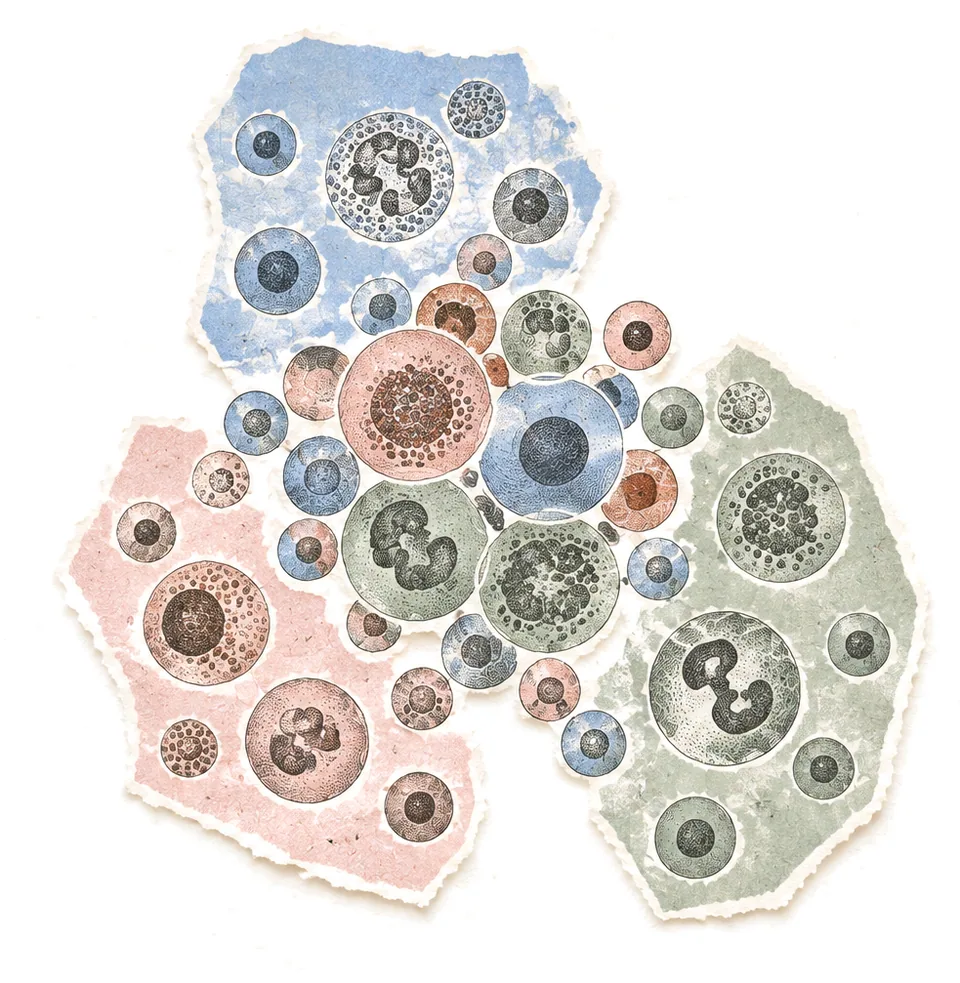
Given raw counts and batch labels of unlabelled multi-batch scRNA-seq datasets (a pretrained single-cell transformer optional), develop an unsupervised integration method that preserves biological variation while aligning comparable cells across batches, and that generalizes across datasets and sources of batch effects.
Cells of the same kind look unlike each other when they come from different experiments, and the question is how to align them without erasing real biological differences. Integration is one of the most heavily benchmarked problems in single-cell genomics: linear correction (Harmony, ComBat, limma), mutual-nearest-neighbour and anchor methods (fastMNN, Scanorama, Seurat, STACAS, scMerge2), batch-balanced graphs (BBKNN), conditional VAEs and their descendants (scVI, sysVI, DRVI, scCRAFT), contrastive objectives (CONCORD, scCobra), generic self-supervision (VICReg) and single-cell foundation models (scGPT, UCE, CellPLM, scPRINT, SCimilarity), whose zero-shot embeddings have been reported not to beat a plain HVG + PCA baseline. It matters because integrated representations are the starting point of nearly every atlas-scale analysis.
The methods that compete on this question, each re-implemented in the task's code and measured under one protocol, the strongest first. Open one for its citation.
He et al., 2025. Partially characterized topology guides reliable anchor-free scRNA-integration. Communications Biology.
The implementation comes with the benchmark's release.
Lopez et al., 2018. Deep generative modeling for single-cell transcriptomics. Nature Methods.
Lotfollahi et al., 2021. Mapping single-cell data to reference atlases by transfer learning. Nature Biotechnology.
The implementation comes with the benchmark's release.
Moinfar and Theis, 2024. Disentangling cellular heterogeneity into interpretable biological factors through structured latent representations.
The implementation comes with the benchmark's release.
Stuart et al., 2019. Comprehensive Integration of Single-Cell Data. Cell.
Hao et al., 2023. Dictionary learning for integrative, multimodal and scalable single-cell analysis. Nature Biotechnology.
The implementation comes with the benchmark's release.
Korsunsky et al., 2019. Fast, sensitive and accurate integration of single-cell data with Harmony. Nature Methods.
The implementation comes with the benchmark's release.
Korsunsky et al., 2019. Fast, sensitive and accurate integration of single-cell data with Harmony. Nature Methods.
The implementation comes with the benchmark's release.
Lin et al., 2019. scMerge leverages factor analysis, stable expression, and pseudoreplication to merge multiple single-cell RNA-seq datasets. Proceedings of the National Academy of Sciences.
Lin et al., 2023. Atlas-scale single-cell multi-sample multi-condition data integration using scMerge2. Nature Communications.
The implementation comes with the benchmark's release.
Zhu et al., 2026. Revealing a coherent cell-state landscape across single-cell datasets with CONCORD. Nature Biotechnology.
The implementation comes with the benchmark's release.
Haghverdi et al., 2018. Batch effects in single-cell RNA-sequencing data are corrected by matching mutual nearest neighbors. Nature Biotechnology.
The implementation comes with the benchmark's release.
Chung and Du, 2025. The Station: An Open-World Environment for AI-Driven Discovery. arXiv preprint.
The implementation comes with the benchmark's release.
Stuart et al., 2019. Comprehensive Integration of Single-Cell Data. Cell.
Hao et al., 2023. Dictionary learning for integrative, multimodal and scalable single-cell analysis. Nature Biotechnology.
The implementation comes with the benchmark's release.
Zhao et al., 2025. scCobra allows contrastive cell embedding learning with domain adaptation for single cell data integration and harmonization. Communications Biology.
The implementation comes with the benchmark's release.
Welch et al., 2019. Single-Cell Multi-omic Integration Compares and Contrasts Features of Brain Cell Identity. Cell.
The implementation comes with the benchmark's release.
Andreatta and Carmona, 2020. STACAS: Sub-Type Anchor Correction for Alignment in Seurat to integrate single-cell RNA-seq data. Bioinformatics.
Andreatta et al., 2024. Semi-supervised integration of single-cell transcriptomics data. Nature Communications.
The implementation comes with the benchmark's release.
Bardes et al., 2022. VICReg: Variance-Invariance-Covariance Regularization for Self-Supervised Learning. The Tenth International Conference on Learning Representations, ICLR 2022, Virtual Event, April 25-29, 2022.
Ovcharenko et al., 2025. scSSL-Bench: Benchmarking Self-Supervised Learning for Single-Cell Data. Proceedings of the 42nd International Conference on Machine Learning.
The implementation comes with the benchmark's release.
Welch et al., 2019. Single-Cell Multi-omic Integration Compares and Contrasts Features of Brain Cell Identity. Cell.
The implementation comes with the benchmark's release.
Johnson et al., 2006. Adjusting batch effects in microarray expression data using empirical Bayes methods. Biostatistics.
The implementation comes with the benchmark's release.
Hrovatin et al., 2025. Integrating single-cell RNA-seq datasets with substantial batch effects. BMC Genomics.
The implementation comes with the benchmark's release.
Hie et al., 2019. Efficient integration of heterogeneous single-cell transcriptomes using Scanorama. Nature Biotechnology.
The implementation comes with the benchmark's release.
Cui et al., 2024. scGPT: toward building a foundation model for single-cell multi-omics using generative AI. Nature Methods.
The implementation comes with the benchmark's release.
Ritchie et al., 2015. limma powers differential expression analyses for RNA-sequencing and microarray studies. Nucleic Acids Research.
The implementation comes with the benchmark's release.
Rosen et al., 2023. Universal Cell Embeddings: A Foundation Model for Cell Biology.
The implementation comes with the benchmark's release.
Xiong et al., 2022. Online single-cell data integration through projecting heterogeneous datasets into a common cell-embedding space. Nature Communications.
The implementation comes with the benchmark's release.
Cui et al., 2024. scGPT: toward building a foundation model for single-cell multi-omics using generative AI. Nature Methods.
The implementation comes with the benchmark's release.
Cui et al., 2024. scGPT: toward building a foundation model for single-cell multi-omics using generative AI. Nature Methods.
The implementation comes with the benchmark's release.
Kalfon et al., 2025. scPRINT: pre-training on 50 million cells allows robust gene network predictions. Nature Communications.
The implementation comes with the benchmark's release.
Wen et al., 2024. CellPLM: Pre-training of Cell Language Model Beyond Single Cells. International Conference on Learning Representations.
The implementation comes with the benchmark's release.
DeMeo and Berger, 2023. SCA: recovering single-cell heterogeneity through information-based dimensionality reduction. Genome Biology.
The implementation comes with the benchmark's release.
Heimberg et al., 2024. A cell atlas foundation model for scalable search of similar human cells. Nature.
The implementation comes with the benchmark's release.
Han et al., 2022. Self-supervised contrastive learning for integrative single cell RNA-seq data analysis. Briefings in Bioinformatics.
The implementation comes with the benchmark's release.
Polański et al., 2019. BBKNN: fast batch alignment of single cell transcriptomes. Bioinformatics.
The implementation comes with the benchmark's release.
Theodoris et al., 2023. Transfer learning enables predictions in network biology. Nature.
The implementation comes with the benchmark's release.
Haghverdi et al., 2018. Batch effects in single-cell RNA-sequencing data are corrected by matching mutual nearest neighbors. Nature Biotechnology.
The implementation comes with the benchmark's release.
Theodoris et al., 2023. Transfer learning enables predictions in network biology. Nature.
Kedzierska et al., 2023. Assessing the limits of zero-shot foundation models in single-cell biology.
Boiarsky et al., 2023. A Deep Dive into Single-Cell RNA Sequencing Foundation Models.
The implementation comes with the benchmark's release.
The implementation comes with the benchmark's release.
The implementation comes with the benchmark's release.
Luecken et al., 2021. Benchmarking atlas-level data integration in single-cell genomics. Nature Methods.
The implementation comes with the benchmark's release.
A method writes the cell representation step: it fits on the raw counts and batch labels of one split of an unlabelled dataset, optionally adapting the pretrained Geneformer or scGPT, and returns an embedding of at most 128 dimensions or a kNN graph for the cells it is given. The datasets, the pretrained transformers, their forward budget and the parameter cap are fixed.
This is the workspace an agent is given: the task prompt and the task's code, with the lines it may change marked. Its submission is the code it leaves in those lines.
Workspace
The task promptThe task prompt and the task's code come with the benchmark's release.
Every method of the task, best first, with its task score out of 100.
Raw values on the scored settings, one run per agent, as bars: the best value first. Each chart says which direction is better.
The OpenProblems batch-integration score of the output, built from scIB metrics of batch removal and of conserved biology.
26 more reference methods are in the numbers below.
26 more reference methods are in the numbers below.
26 more reference methods are in the numbers below.
26 more reference methods are in the numbers below.
25 more reference methods are in the numbers below.
25 more reference methods are in the numbers below.
25 more reference methods are in the numbers below.
| Method | ① | ② | ③ | ④ | ⑤ | ⑥ | ⑦ |
|---|---|---|---|---|---|---|---|
| Claude Fable 5.2 | 0.849 | 0.736 | 0.625 | 0.792 | 0.604 | 0.604 | 0.772 |
| Claude Opus 5.5 | 0.812 | 0.736 | 0.549 | 0.776 | 0.613 | 0.598 | 0.692 |
| scCRAFT | 0.822 | 0.720 | 0.574 | 0.792 | 0.584 | 0.602 | 0.632 |
| scVI | 0.756 | 0.720 | 0.521 | 0.751 | 0.573 | 0.580 | 0.676 |
| DRVI | 0.721 | 0.683 | 0.477 | 0.743 | 0.526 | 0.543 | 0.683 |
| Seurat RPCA | 0.758 | 0.680 | 0.522 | 0.750 | 0.493 | 0.525 | 0.624 |
| Muse Wonder Full | 0.785 | 0.661 | 0.473 | 0.762 | 0.504 | 0.493 | 0.634 |
| Harmony | 0.757 | 0.694 | 0.501 | 0.738 | 0.537 | 0.542 | 0.583 |
| Harmony, R package | 0.723 | 0.667 | 0.499 | 0.702 | 0.530 | 0.562 | 0.675 |
| scMerge2 | 0.726 | 0.675 | 0.507 | 0.704 | 0.509 | 0.536 | 0.630 |
| CONCORD | 0.685 | 0.642 | 0.532 | 0.647 | 0.554 | 0.565 | 0.696 |
| fastMNN | 0.718 | 0.704 | 0.456 | 0.734 | 0.480 | 0.531 | 0.621 |
| Density-Adaptive BBSG | 0.691 | 0.673 | 0.494 | 0.678 | 0.566 | 0.549 | 0.629 |
| Seurat CCA | 0.744 | 0.621 | 0.490 | 0.721 | 0.502 | 0.518 | 0.634 |
| scCobra | 0.720 | 0.675 | 0.479 | 0.681 | 0.522 | 0.528 | 0.613 |
| LIGER, R package | 0.683 | 0.632 | 0.478 | 0.766 | 0.523 | 0.512 | 0.589 |
| Qwen4-Max | 0.709 | 0.655 | 0.483 | 0.658 | 0.509 | 0.530 | 0.617 |
| STACAS | 0.713 | 0.653 | 0.446 | 0.727 | 0.485 | 0.501 | 0.588 |
| VICReg | 0.577 | 0.617 | 0.462 | 0.727 | 0.560 | 0.573 | 0.635 |
| LIGER | 0.669 | 0.620 | 0.482 | 0.738 | 0.513 | 0.532 | 0.567 |
| ComBat | 0.712 | 0.572 | 0.481 | 0.655 | 0.492 | 0.531 | 0.665 |
| sysVI | 0.691 | 0.663 | 0.488 | 0.651 | 0.494 | 0.539 | 0.585 |
| Scanorama | 0.686 | 0.678 | 0.381 | 0.654 | 0.494 | 0.429 | 0.578 |
| Kimi K3.1 Pro | 0.663 | 0.580 | 0.430 | 0.693 | 0.538 | 0.494 | 0.564 |
| scGPT, ECS + DAB | 0.545 | 0.639 | 0.469 | 0.676 | 0.490 | 0.547 | 0.607 |
| limma removeBatchEffect | 0.600 | 0.497 | 0.459 | 0.697 | 0.444 | 0.490 | 0.612 |
| GPT-6.2 Astra | 0.540 | 0.489 | 0.409 | 0.686 | 0.458 | 0.528 | 0.573 |
| Zero-shot UCE | 0.532 | 0.610 | 0.448 | 0.530 | 0.497 | 0.542 | 0.570 |
| SCALEX | 0.546 | 0.541 | 0.499 | 0.615 | 0.466 | 0.450 | 0.485 |
| Zero-shot scGPT | 0.493 | 0.523 | 0.431 | 0.567 | 0.491 | 0.535 | 0.517 |
| scGPT fine-tuned, OpenProblems | 0.466 | 0.515 | 0.432 | 0.557 | 0.486 | 0.504 | 0.540 |
| Zero-shot scPRINT | 0.424 | 0.558 | 0.446 | 0.537 | 0.505 | 0.454 | 0.546 |
| Zero-shot CellPLM | 0.515 | 0.483 | 0.364 | 0.555 | 0.471 | 0.472 | 0.521 |
| SCA | 0.498 | 0.408 | 0.327 | 0.574 | 0.434 | 0.474 | 0.508 |
| Zero-shot SCimilarity | 0.460 | 0.495 | 0.365 | 0.546 | 0.420 | 0.453 | 0.504 |
| HVG + PCA | 0.425 | 0.476 | 0.290 | 0.543 | 0.451 | 0.476 | 0.414 |
| Frozen Geneformer | 0.315 | 0.417 | 0.365 | 0.504 | 0.461 | 0.426 | 0.408 |
| CLEAR | 0.340 | 0.398 | 0.333 | 0.505 | 0.410 | 0.442 | 0.366 |
| BBKNN | 0.462 | 0.430 | 0.301 | 0.410 | 0.290 | 0.326 | 0.358 |
| Geneformer, continued MLM | 0.342 | 0.374 | 0.325 | 0.451 | 0.432 | 0.416 | 0.346 |
| Constant embedding | 0.440 | 0.447 | 0.443 | 0.439 | 0.424 | 0.425 | 0.427 |
| Random-target MLM | 0.252 | 0.303 | 0.342 | 0.325 | 0.326 | 0.311 | 0.366 |
| mnnCorrect | 0.693 | 0.647 | 0.381 | 0.685 |
The scIB biological-conservation subscore, which measures how well biological structure among the cells survives integration.
25 more reference methods are in the numbers below.
The bars start at 0.672, not at zero.
26 more reference methods are in the numbers below.
The bars start at 0.606, not at zero.
26 more reference methods are in the numbers below.
The bars start at 0.761, not at zero. A bar with a notched end runs beyond the chart; its number is exact.
25 more reference methods are in the numbers below.
25 more reference methods are in the numbers below.
24 more reference methods are in the numbers below.
24 more reference methods are in the numbers below.
| Method | ① | ② | ③ | ④ | ⑤ | ⑥ | ⑦ |
|---|---|---|---|---|---|---|---|
| Claude Fable 5.2 | 0.892 | 0.734 | 0.665 | 0.783 | 0.563 | 0.533 | 0.702 |
| Claude Opus 5.5 | 0.861 | 0.722 | 0.646 | 0.776 | 0.683 | 0.631 | 0.785 |
| scCRAFT | 0.826 | 0.753 | 0.700 | 0.784 | 0.709 | 0.621 | 0.667 |
| scVI | 0.847 | 0.747 | 0.677 | 0.791 | 0.732 | 0.649 | 0.772 |
| DRVI | 0.827 | 0.735 | 0.645 | 0.789 | 0.734 | 0.647 | 0.771 |
| Seurat RPCA | 0.876 | 0.756 | 0.656 | 0.784 | 0.649 | 0.585 | 0.773 |
| Muse Wonder Full | 0.908 | 0.735 | 0.684 | 0.799 | 0.616 | 0.544 | 0.698 |
| Harmony | 0.894 | 0.760 | 0.708 | 0.750 | 0.707 | 0.628 | 0.743 |
| Harmony, R package | 0.828 | 0.756 | 0.716 | 0.789 | 0.694 | 0.623 | 0.715 |
| scMerge2 | 0.834 | 0.728 | 0.604 | 0.755 | 0.593 | 0.643 | 0.642 |
| CONCORD | 0.803 | 0.697 | 0.656 | 0.750 | 0.683 | 0.626 | 0.789 |
| fastMNN | 0.841 | 0.771 | 0.694 | 0.807 | 0.692 | 0.635 | 0.723 |
| Density-Adaptive BBSG | 0.798 | 0.721 | 0.646 | 0.759 | 0.513 | 0.458 | 0.659 |
| Seurat CCA | 0.861 | 0.710 | 0.559 | 0.766 | 0.633 | 0.574 | 0.749 |
| scCobra | 0.806 | 0.744 | 0.682 | 0.776 | 0.693 | 0.640 | 0.708 |
| LIGER, R package | 0.681 | 0.665 | 0.590 | 0.761 | 0.619 | 0.542 | 0.645 |
| Qwen4-Max | 0.858 | 0.744 | 0.695 | 0.722 | 0.700 | 0.618 | 0.833 |
| STACAS | 0.835 | 0.743 | 0.689 | 0.785 | 0.687 | 0.604 | 0.785 |
| VICReg | 0.631 | 0.702 | 0.424 | 0.788 | 0.660 | 0.602 | 0.728 |
| LIGER | 0.720 | 0.658 | 0.585 | 0.737 | 0.614 | 0.553 | 0.619 |
| ComBat | 0.838 | 0.713 | 0.665 | 0.777 | 0.698 | 0.641 | 0.677 |
| sysVI | 0.858 | 0.710 | 0.714 | 0.757 | 0.707 | 0.648 | 0.748 |
| Scanorama | 0.822 | 0.766 | 0.677 | 0.779 | 0.722 | 0.641 | 0.692 |
| Kimi K3.1 Pro | 0.869 | 0.727 | 0.659 | 0.756 | 0.548 | 0.475 | 0.708 |
| scGPT, ECS + DAB | 0.726 | 0.742 | 0.725 | 0.766 | 0.705 | 0.639 | 0.742 |
| limma removeBatchEffect | 0.727 | 0.696 | 0.677 | 0.784 | 0.686 | 0.649 | 0.677 |
| GPT-6.2 Astra | 0.793 | 0.734 | 0.701 | 0.788 | 0.715 | 0.651 | 0.733 |
| Zero-shot UCE | 0.664 | 0.717 | 0.677 | 0.702 | 0.723 | 0.650 | 0.679 |
| SCALEX | 0.641 | 0.568 | 0.563 | 0.664 | 0.529 | 0.502 | 0.518 |
| Zero-shot scGPT | 0.687 | 0.691 | 0.692 | 0.746 | 0.690 | 0.637 | 0.664 |
| scGPT fine-tuned, OpenProblems | 0.686 | 0.728 | 0.671 | 0.730 | 0.709 | 0.638 | 0.697 |
| Zero-shot scPRINT | 0.590 | 0.658 | 0.648 | 0.567 | 0.614 | 0.591 | 0.584 |
| Zero-shot CellPLM | 0.697 | 0.708 | 0.684 | 0.710 | 0.709 | 0.644 | 0.700 |
| SCA | 0.721 | 0.659 | 0.677 | 0.744 | 0.718 | 0.651 | 0.674 |
| Zero-shot SCimilarity | 0.710 | 0.732 | 0.691 | 0.753 | 0.735 | 0.667 | 0.747 |
| HVG + PCA | 0.723 | 0.698 | 0.684 | 0.706 | 0.720 | 0.660 | 0.691 |
| Frozen Geneformer | 0.548 | 0.641 | 0.639 | 0.525 | 0.674 | 0.612 | 0.640 |
| CLEAR | 0.561 | 0.642 | 0.679 | 0.628 | 0.699 | 0.628 | 0.648 |
| BBKNN | 0.969 | 0.822 | 0.665 | 0.845 | 0.641 | 0.583 | 0.673 |
| Geneformer, continued MLM | 0.545 | 0.624 | 0.630 | 0.623 | 0.702 | 0.617 | 0.626 |
| Constant embedding | 0.350 | 0.357 | 0.342 | 0.349 | 0.369 | 0.375 | 0.360 |
| Random-target MLM | 0.389 | 0.335 | 0.332 | 0.349 | 0.303 | 0.306 | 0.317 |
| mnnCorrect | 0.802 | 0.765 | 0.685 | 0.789 |
One run per model.
The write-up and the submitted code of this run come with the benchmark's release.
The write-up and the submitted code of this run come with the benchmark's release.
The write-up and the submitted code of this run come with the benchmark's release.
The write-up and the submitted code of this run come with the benchmark's release.
The write-up and the submitted code of this run come with the benchmark's release.
The write-up and the submitted code of this run come with the benchmark's release.
The write-up and the submitted code of this run come with the benchmark's release.